
An interrailing adventure
You’ll need
- Scenario cards
- True or false cards
- Themed snacks for each of the stations (optional)
- Whistle (optional)
Before you begin
- Use the safety checklist to help you plan and risk assess your activity. There's also more guidance to help you carry out your risk assessment, including examples.
- Make sure all young people and adults involved in the activity know how to take part safely.
- Make sure you’ll have enough adult helpers. You may need some parents and carers to help if you’re short on helpers.
Planning and setting up this activity
- Print out a copy of the True or False cards, for people to sort. You’ll need a copy of the guidance notes, too.
- Set up six stations around the meeting space. Print out the six scenario cards and place one at each station.
- Print out copies of the guidance for volunteers who’ll be supporting the stations.
- You could add some themed snacks for people to enjoy at each station. For example, croissant or madeleines (little sponge cakes) for France, pretzels for Germany, speculoos (spiced biscuits) or chocolate pralines for Belgium and Paluszki (pretzel sticks) or Ptasie mleczko (chocolate-covered marshmallow bars) for Poland.
- You could do this activity in preparation for an international expedition, event or interrailing journey.
Running this activity
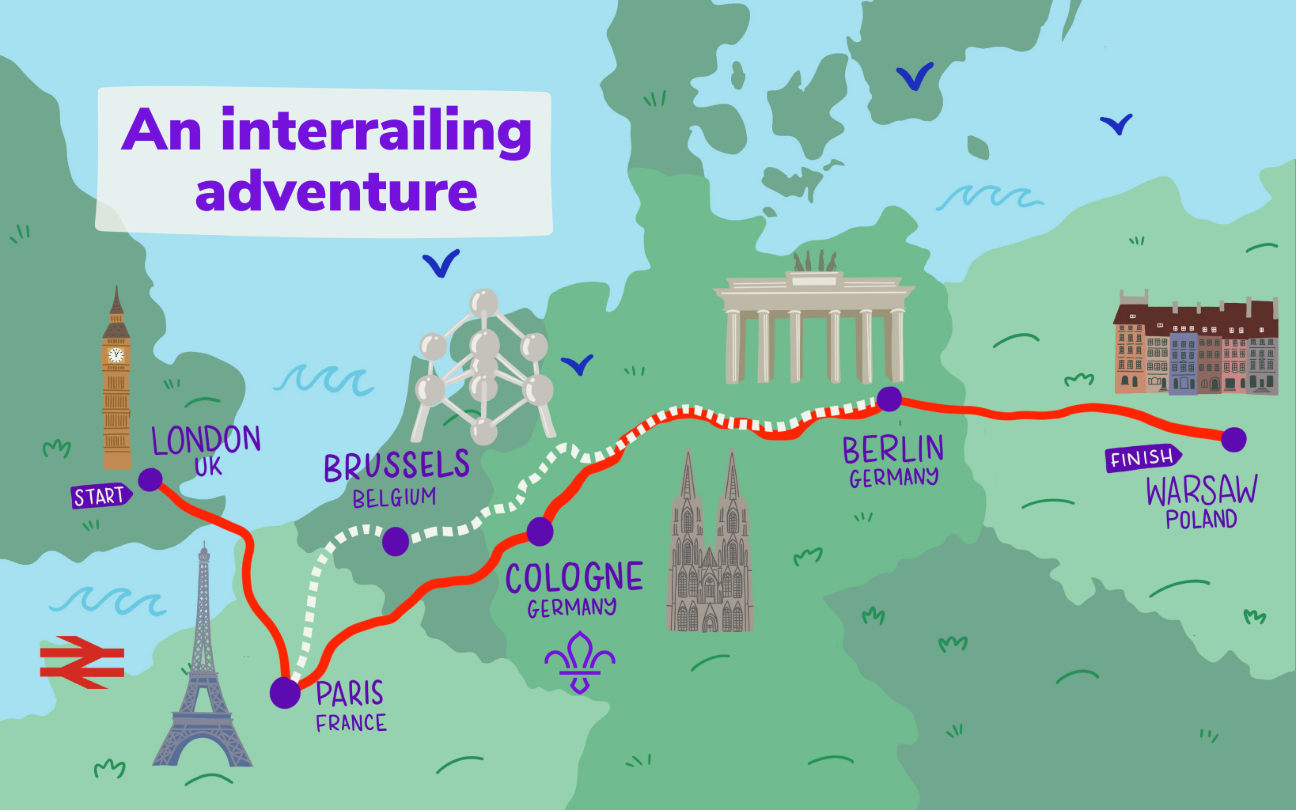
- Explain that everyone will be going on an imaginary train journey from UK to Warsaw in Poland. They’ll travel through several countries along the way. At each station, they’ll face a different scenario or challenge.
- Get everyone into small groups and explain that they’ll be taking turns to start the journey, and they'll spend a few minutes at each station. You can adjust the timing depending on how much time you’ve got available.
- Explain that while groups are waiting to begin and after they’ve finished the journey, they’ll be in the main space, completing a true-or-false activity about railways around the world.
- If there are snacks at the stations, explain how these should be shared - for example, one per person, or one per group.
- Start the first group at the first station.
- Give the true-or-false cards to remaining groups, so they can start sorting them together, and encourage discussion as they decide.
- After a few minutes, blow the whistle, or give another signal that it’s time to move. The first group moves to the second station, and the next group starts their journey at the first station.
- Continue rotating groups until everyone has visited all stations.
- Gather everyone together to go through the answers to the true or false activity, and to reflect on the journey they went on. You can use the prompts in the Reflection section on this page, to support the discussion.
Stations
Scenario:
You’ll be travelling through France and Germany to get to your destination in Poland. You’re waiting for your first train, from London to Paris, and your passport drops onto the tracks.
Discussion prompts:
- What do you need to consider or do in this situation?
- How might this be the same or different if it happened later in your journey, in another country?
Guidance for leaders:
- Step away from the platform edge. Your safety comes first — trains can arrive silently and very quickly. Do not try to reach it yourself or use anything to fish it out.
- Alert railway staff immediately. Speak to a member of staff on the platform, or use a help point if there is one.
- In the UK, Help Points are usually round with two buttons: “emergency” or “information.” Press the emergency button.
- Explain clearly what happened. Tell staff exactly what fell and where, and point out the location.
- Some countries, like France, have a specific emergency number for safety issues on trains and at stations. You need to tell them the station you are calling from.
Scenario:
You were due to travel through Germany, getting a train to Cologne, but the main line from Paris to Cologne is blocked. You have to travel via Belgium to continue your journey.
Discussion prompts:
- What would be important to find out about travelling by train in this country?
- How could you find this information?
Guidance for leaders:
- Check ticket rules and boarding procedures.
- Follow local safety rules, which may differ between countries, and know the local emergency number in case you need help.
- Be aware of travel etiquette, such as queuing, rules and expectations on trains (e.g. eating, using mobiles).
- Use official sources such as station staff, railway websites or apps, maps, and signage. If unsure, ask staff rather than guessing.
Scenario:
You’ve got time to spare in Brussels before the next train, so you go exploring in the city. You notice metal tracks and white lines on the road, and can hear a bell ringing.
Discussion prompts:
- What is it and what should you do?
- Some people are starting to cross between the tracks - what should you do?
Guidance for leaders:
- In Brussels, many trams share the road with cars, cyclists, and pedestrians. The metal tracks and white lines mark tram lanes.
- The bell warns that a tram is approaching or moving. Trams cannot swerve and take a long distance to stop.
- If you hear a bell, stay off the tracks, even if the tram seems far away.
- Shared streets like this exist in many historic city centres.
- Always use designated crossings where possible.
Scenario:
You’re staying overnight in Cologne, before continuing your journey across Germany tomorrow. On the way to the youth hostel, you spot a car broken down on a level crossing.
Discussion prompts:
- What do you do?
- What do you need to consider or do in this situation?
- How is this the same or different from the UK?
Guidance for leaders:
- Look for any emergency signs or instructions at the crossing.
- Dial 112, the emergency number across Europe (different from the UK). The call is free.
- Clearly explain the location of the incident. Some countries, like Poland and Belgium, have crossing ID numbers to help emergency services locate the site.
- In the UK, most level crossings have a telephone on the barrier post, often with an ID number.
Scenario:
You’re now on the train from Berlin to Warsaw, and the train is entering Poland. Your friend is excited and wants to take a photo - they think they can see a village with traditional red roofs and a river in the distance. They want to lean out of the window to get a better view.
Discussion prompts:
- What do you do?
- How might peer pressure affect what people do around trains?
- Have you ever seen someone break safety rules around trains? How did it make you feel, and what would you do in that situation?
Guidance for leaders:
- Never lean out of train windows while the train is moving — trains can sway or pass close to objects, even if it looks safe.
- Take photos from inside the train; there will be plenty of views to enjoy when you arrive.
- Just because a window can open fully does not mean it’s safe. Lack of safety features does not make it less risky. Many windows only tilt for ventilation, and some trains automatically lock doors while moving, but others do not.
Scenario:
You've arrived safely in Poland and settled into the campsite. While walking as a group to an off-site activity, you come across a level crossing. There’s a half barrier down and flashing lights. Locals cross casually. You’re tired, excited, and behind schedule.
Discussion prompts:
- What do you need to consider or do in this situation?
- How do you know if it’s safe to cross? Would you cross? Why or why not?
- How is this the same or different from the UK?
- How might peer pressure or the actions of locals influence you?
Guidance for leaders:
- Never cross when barriers are down or lights are flashing; trains can appear silently and take a long distance to stop.
- Follow official rules, not locals - just because others cross casually doesn’t make it safe.
- Know the local emergency number (112 in Poland and across Europe) in case of incidents.
- Stay calm and make safe choices, even if friends or locals are crossing.
- In Poland, trains run on the right-hand side of the tracks.
Answer: TRUE. It usually (but not always) matches road traffic rules. In the UK, trains run on the left, but in many other countries they run on the right. In most European countries, they run on the right.
- In the UK, all level crossings have barriers.
Answer: FALSE. Some level crossings have only lights or signs, and don't have any physical barriers, especially on quieter or rural lines. In many other countries, this is more common, and crossings might have very limited warning systems.
- If a level crossing doesn’t have a barrier, it means it’s safer than one that does.
Answer: FALSE. Level crossings come in different types. Some crossings may only have warning lights or signs, but that doesn’t make them safer than those with barriers. - They rely entirely on your responsibility to judge when it’s safe to cross. Always stop look and listen, and remember that trains can be quieter, faster, and harder to see, especially around curves.
- The world’s highest railway station is over twice as high as Ben Nevis, the highest mountain in the UK.
Answer: TRUE. Jungfraujoch railway station in Switzerland sits at 3,454 m above sea level, while Ben Nevis in Scotland is 1,345 m.
- In some countries, it’s normal for people to walk across or along railway tracks in rural areas.
Answer: TRUE. But this is dangerous and often illegal. Just because locals do it doesn’t mean it’s safe or legal for you.
For example, in many rural and urban areas in India, people regularly cross railway tracks where there are no formal crossings. Trains often pass at high speed, sometimes with little warning, and the tracks are frequently used as shortcuts between villages or neighbourhoods.
- Some Swiss trains go so high in the mountains that passengers need special oxygen in the cabins.
Answer: FALSE. While some Swiss trains, like the Jungfrau and Gornergrat Railways, reach over 3,000 m, passenger cabins do not provide special oxygen. The thinner air can make breathing slightly harder and some visitors may feel breathless or slightly affected by the reduced oxygen at that altitude.
- Railway rules and safety systems are the same across all European countries.
Answer: FALSE. Railways are not standardised globally and even across Europe there are differences. It's important to do your research before you travel. Never assume that things will work the same as in the UK, and don’t assume a situation is safe just because there’s no warnings, safety measures or because locals do it.
- The UK has the fastest trains in Europe.
Answer: FALSE. France’s TGV and Germany’s ICE trains are faster than any trains currently operating in the UK. The TGV can reach around 200 mph (320 km/h) and the ICE about 190 mph (300 km/h). In comparison, the UK’s fastest trains run at 125–140 mph, though the planned HS2 line will reach higher speeds. Assuming UK trains are the fastest could lead to underestimating how quickly trains travel in other countries.
- In some countries, it's common for people to ride on the roof of trains or outside carriages.
Answer: TRUE. This usually happens due to overcrowding or lack of alternatives. This is extremely dangerous and causes many injuries and deaths. It’s illegal in many countries including the UK.
- The longest railway in the world is over 9,000 km long.
Answer: TRUE. The Trans-Siberian Railway in Russia is about 5,772miles (9,289 km). It’s like travelling across Europe twice!
- In parts of the world, animals regularly cross railway lines, and trains are designed to slow down for them.
Answer: TRUE. In some regions, trains may slow down for animals such as elephants, cattle, or reindeer. For example, in Switzerland, trains sometimes reduce speed to allow cows to safely cross tracks in the Alps. Even where trains are slowed for animals, crossings remain dangerous and unpredictable, and people should never assume a train can stop for them.
- Trespassing on railway lines is illegal in all countries.
Answer: FALSE. It’s illegal in the UK, but laws and enforcement vary widely around the world. Even where it’s not illegal, it can still be very dangerous.
- In Japan, it's considered very serious if a train arrives even one minute late.
Answer: TRUE. Punctuality is extremely important in Japan. Train companies and staff take even a one-minute delay very seriously.
- Freight trains can be over 2.5miles (4 km) long.
Answer: TRUE. Some freight trains in Australia and the US are extremely long. The longest freight train was in Australia, stretching over 4.5miles (7km) with 682 cars powered by eight locomotives.
- In China, it’s common to queue orderly when boarding high-speed trains.
Answer: TRUE. In some countries, boarding can be chaotic, with people pushing or crowding onto trains. In China, passengers line up in an orderly queue, which helps prevent overcrowding and accidents on platforms.
- Some trains use AI to automatically detect obstacles on the tracks.
Answer: TRUE. AI cameras and sensors can detect animals, people, or debris on the tracks, and alert the driver or in some cases, trigger emergency braking automatically.
- Poland uses staged train accidents to teach people about railway safety.
Answer: TRUE. These are carefully planned simulations, not real accidents. They demonstrate how trains cannot stop quickly and why ignoring barriers, signals, or warning lights is extremely dangerous.This is part of Poland’s Safe Crossing campaign, which aims to reduce accidents and deaths at level crossings
Reflection
This activity helped everyone think about how to stay safe around railways, including when travelling abroad. It was a valuable opportunity to develop critical thinking, problem-solving, and decision-making skills, while also learning to be responsible for yourself and others.
Here are some prompt questions you could use to get everyone thinking:
- Did you learn anything that surprised you?
- What is the most important thing you will take away from this session?
- What do you need to consider when planning a trip abroad to stay safe and responsible?
Safety
All activities must be safely managed. You must complete a thorough risk assessment and take appropriate steps to reduce risk. Use the safety checklist to help you plan and risk assess your activity. Always get approval for the activity, and have suitable supervision and an InTouch process.
You must run your activities in line with the Safeguarding Code of Conduct for Adults (Yellow Card) and report any concerns to the UK HQ Safeguarding Team.
- Food
Remember to check for allergies, eating problems, fasting or dietary requirements and adjust the recipe as needed. Make sure you’ve suitable areas for storing and preparing food and avoid cross contamination of different foods. Take a look at our guidance on food safety and hygiene.
- To make this activity easier, you could use fewer or easier statements in the true-or-false activity. You could provide visual prompts or images alongside the scenarios to support understanding, and give hints or multiple-choice options for what the safest action would be.
- To make this activity harder, you could introduce more complex or ambiguous scenarios that require critical thinking to decide the safest action.
- Make sure everyone can understand the story, scenario, text, play, or book by using large, easy-to-read fonts, simple words, and adding images. If someone struggles with reading, they can work with a friend, young leader, or adult. Always encourage people to ask if they don’t understand any words. Support reading activities with visual aids such as pictures, emojis, symbols, or drawings. You can also offer alternative ways to take part, such as using a picture guide for recipe steps, a visual packing list, acting out ideas, using colours and shapes to help recognise items without reading, or having discussions. Audio versions (such as videos or audiobooks) can be helpful too. For those with dyslexia, light-coloured paper (such as cream or pale pink) or coloured overlays can make reading easier. You could also provide options, such as magnifying glasses, digital text with magnification or read-aloud features, braille or large print.
- People can work in pairs or small groups as needed. For example, if someone doesn’t want to go alone during a game or activity, or if they might struggle with something, their partner can help them. If needed, bigger groups can be used to make sure everyone feels supported and can take part. Depending on what works best, everyone could also work together as one big group. An adult or young leader should always be available to help and support everyone.
All Scout activities should be inclusive and accessible.
If you enjoyed this activity, why not learn more about railway safety with our other rail safety activities.
This activity could be used towards the Teamwork Challenge Award, with Scouts working as part of a team, communicating and making decisions together, all with the goal of completing the journey safely.