Train safety obstacle course
You’ll need
- Chalk, masking tape, cones or ropes
- Foam football
- Obstacles (optional)
Before you begin
- Use the safety checklist to help you plan and risk assess your activity. There's also more guidance to help you carry out your risk assessment, including examples. Don’t forget to make sure all young people and adults involved in the activity know how to take part safely.
Setting up the course
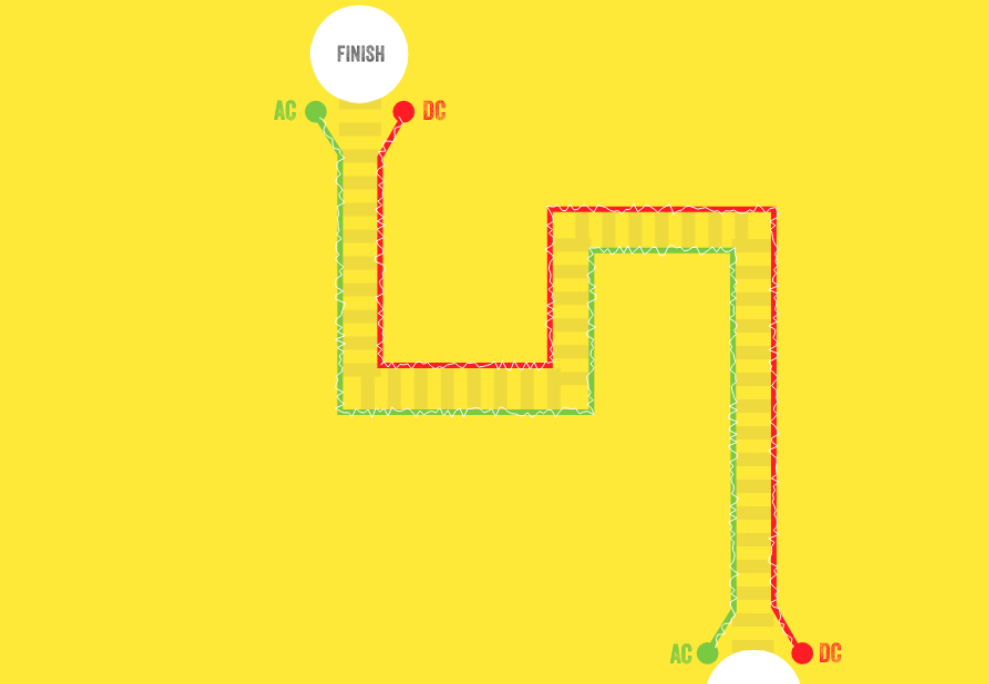
- Use chalk, masking tape, cones or ropes to make the course. Mark a path using two lines, with enough space between them for young to dribble a football down. One line will represent the overhead lines (alternating current/AC) and one line represent the third rail (direct current/DC).
- The course path can be made harder with narrow turns and bends, or it could be kept simple with one straight, wide path.
- Make sure the path is accessible for everyone in your group. For example, it may need to be wider for mobility aids.
Running this activity
-
Explain that there are two big electrical dangers on railways: overhead lines and the third rail.
-
Overhead lines hang above the train tracks and carry AC (alternating current). Overhead lines carry 25,000 volts of electricity (100 times stronger than household power) and can arc (jump) up to three metres through the air. You don’t have to touch them to get hurt.
-
The third rail, which runs along the ground beside the track and carries DC (direct current). It carries 750 volts and is hard to spot. Touching it can cause serious burns, nerve damage, or even death. The electricity is so powerful it can hold you in place.
-
Play the game
- Explain that you’re going to play a game where you need to try to move around a ‘train station’, while staying safe and avoiding the electricity.
- Ask if anyone knows any ways we can keep safe at a railway station and near railway lines. You can find some answers on this page.
- Ask everyone to get into teams. There should be a course and a ball for each team.
- People should dribble the football through the course, without the ball or themselves touch the sides.
- Once they’re finished, they need to take the ball back to the next person.
- You could demonstrate the course, so people know what they’re doing.
- You could also use a smaller ball and a hockey stick for people to use to dribble the ball through, instead of a football.
- Someone should be note down any time a team touches the sides. You could send them back to the start or offer a time penalty for each touch.
- Someone else should also be timing each group and writing down the times.
- Once everyone’s ready, the first person for each team can go.
- At the end, tell everyone which team completed it the fastest. Make sure to include any time penalties for touching the sides if you’re doing it this way.
- Remember, this game is just for fun—it’s not a real-life example. Railways are dangerous if we’re not careful. Trains move fast, tracks can be electrified, and people are seriously injured or killed every year. Never trespass, never play near tracks, and never touch overhead lines or the third rail. The electricity is always on—stay safe and stay away!
Some things we can do are:
- Never trespass on a railway. It’s illegal. Trespassing includes stepping off a level crossing onto an area where you shouldn’t be, picking up lost property from the tracks, crossing the tracks at any point other than at a level crossing or taking a walk down the side of the railway track
- Keep away from the platform edge. Stay behind the marked yellow/white platform edge lines whilst waiting on the platforms.
- Make sure you apply the brakes to prams and strollers, and always position them parallel to the tracks.
- Always walk around a train station, never run.
- Hold the handrail and concentrate on your footing.
- Keep yourselves and others safe by reporting any unusual items or activity on the railway.
- Take extra care getting on and off a train and mind the gap.
- Never go near the overhead power lines.
- Never play on or near the train tracks, including never walking on or near them.
- Never throw anything onto the tracks or at the lines.
- Wait at and use level crossings to cross railways, following the signs.
- Stay with your grown up at the station.
- Never pick up or rescue anything from the tracks or near them, even if you dropped it. If you drop something on the track, leave it and contact a member of staff.
Reflection
This activity was all about electricity at the railway. Have any of you ever seen a railway before, such as on a train or station? What did you do to stay safe? If you have never been to a railway before, has this helped you feel more confident in what to expect? Is there anything you are nervous about? Can you remember any of the ways to stay safe at a railway station?
You can help keep others safe at railways stations too. What do you think you can do? If you see someone looking upset at the train station, tell a responsible adult, such as the grown up you’re with or someone who works at the train station. Never approach a stranger without a responsible adult.
Safety
All activities must be safely managed. You must complete a thorough risk assessment and take appropriate steps to reduce risk. Use the safety checklist to help you plan and risk assess your activity. Always get approval for the activity, and have suitable supervision and an InTouch process.
You must run your activities in line with the Safeguarding Code of Conduct for Adults (Yellow Card) and report any concerns to the UK HQ Safeguarding Team.
- Active games
The game area should be free of hazards. Explain the rules of the game clearly and have a clear way to communicate that the game must stop when needed. Take a look at our guidance on running active games safely.
This activity could be made harder by adding some extra obstacles, such as cones or a pop-up tunnel.
- Make sure there’s a role for everyone. If anyone doesn’t want to play the game, they can take on another role, such as scorekeeping or reminding people of the instructions throughout the game.
- If needed, let people be in bigger groups to make sure everyone’s supported in taking part in the activity. A young leader could join a group to help people to take part too.
- Check for understanding by asking the group questions, such as ‘what do you need to do first?’ or having a practice round of a game. If people are struggling to understand or know what to do, you could let any confident young people help explain to each other what to do.
- For anyone who may not be able to move around your meeting place easily, think about how you could set up the obstacle course or game to meet everyone's needs.
All Scout activities should be inclusive and accessible.
Try some other activities to continue learning about rail safety.