

Marshmallow constellations
You’ll need
- Cocktail sticks
- Mini marshmallows
- Black paper
- Pictures of constellations
Before you begin
- Use the safety checklist to help you plan and risk assess your activity. There's also more guidance to help you carry out your risk assessment, including examples.
- Make sure you’ll have enough adult helpers. You may need some parents and carers to help.
Planning and setting up this activity
- For this activity, you’ll need to collect some pictures of constellations for people to copy. You could use websites, such as Star Registration’s constellation guide.
- Marshmallows aren’t recommended for Under 5’s. You could use something else instead, such as chopped fruit. Use the UK Government’s meal safety advice for four and five year olds to prevent choking.
- Check for allergies, intolerances, fasting, food-related medical conditions, eating problems, food sensitivities or dietary requirements, then adjust the food items used as needed. This may include making sure there’s no cross-contamination of packaging and no cross-contamination during the storage, preparation, cooking and serving.
- You may need to use separate chopping boards, equipment and utensils, such as tongs or toasters, for different dietary requirements, allergies and foods.
- If you’re unsure, check with the young person and their parents or carers. You can check with the adult directly if it’s a volunteer or helper.
- Some people may not like certain food textures or tastes and that’s OK. People don’t need to use all the ingredients if they don’t want to, and no-one should be made to try foods if they don’t want to. You can try to find an alternative for them
Running this activity
- Gather everyone together and explain that you’re going to learn about stars.
- Explain that stars are giant balls of glowing gas, and the Sun is the closest star to us. Most of the little lights we see at night are stars, but many more are too far away to see without a telescope. Stars are found in large groups called galaxies, and our Sun is part of the Milky Way galaxy. Stars come in different sizes and colours. The Sun’s somewhere in between. It gives off yellow light. The Sun is an average star in terms of its brightness and size. Inside stars, gas gets squeezed and makes energy, which is why stars shine so brightly.
- A constellation’s a group of stars in the night sky that forms a recognizable shape or pattern, often resembling animals, objects, or people. Many of these patterns are named after mythological figures from ancient stories. There are 88 major constellations, but you can’t see all of them at the same time, and some are difficult to spot without a telescope—especially those that are visible during the day. What constellations you can see also depends on where you are in the world.
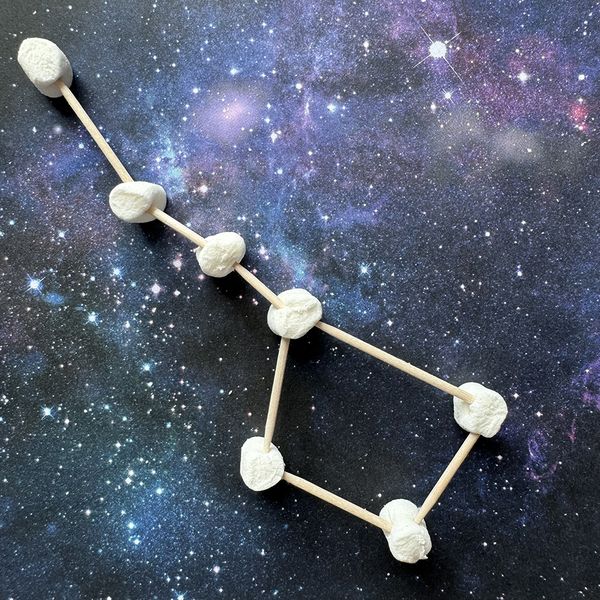
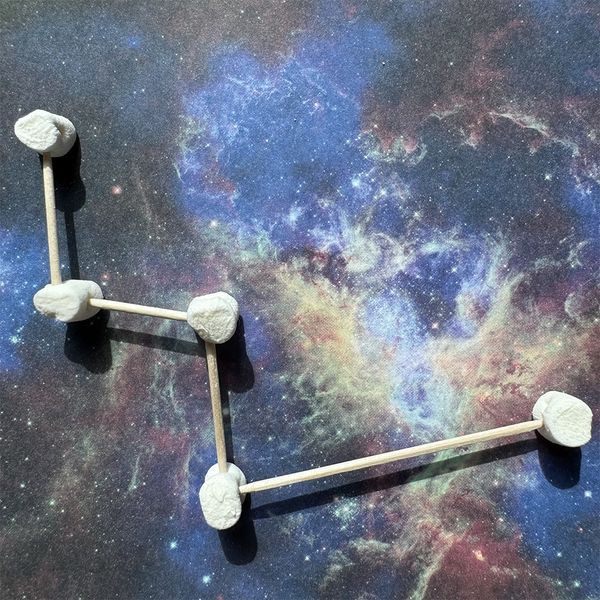
- Show everyone some pictures of different constellations. You could talk about the name of each one, what it looks like and any facts about.
- Now, let everyone choose a constellation they want to make.
- Give everyone the mini marshmallows and cocktails sticks, then let them create their own constellation. People could make more if you have time.
- At the end, place all the marshmallow constellations on large sheets of black paper and create your own night sky.
- You could even go stargazing and see if you can spot the constellations you’ve made!
Reflection
In this activity, everyone learned about constellations and stars, got to try something new and created something on their own. You made your own constellation. What was this like? What was easy? What was hard? Why did you choose the constellation you did? Have you seen it in the sky, or will you now see if you can spot it? Did you work with anyone else to make the constellations? How well did you work together? What did you learn about the stars or constellations? What else would you like to learn about in space?
Safety
All activities must be safely managed. You must complete a thorough risk assessment and take appropriate steps to reduce risk. Use the safety checklist to help you plan and risk assess your activity. Always get approval for the activity, and have suitable supervision and an InTouch process.
You must run your activities in line with the Safeguarding Code of Conduct for Adults (Yellow Card) and report any concerns to the UK HQ Safeguarding Team.
- Food
Remember to check for allergies, eating problems, fasting or dietary requirements and adjust the recipe as needed. Make sure you’ve suitable areas for storing and preparing food and avoid cross contamination of different foods. Take a look at our guidance on food safety and hygiene.
- Sharp objects
Teach young people how to use sharp objects safely. Supervise them appropriately throughout. Store all sharp objects securely, out of the reach of young people.
To make it easier, you could pre-draw the constellations on paper for people to copy.
If anyone doesn’t feel comfortable making the constellations or touching the marshmallows, they could wear gloves or work with someone else. They could also use jelly sweets or fruit instead.
All Scout activities should be inclusive and accessible.

You could give the young people the opportunity to do some research on constellations before this activity and ask them to bring the information they find along with them.