Campfire safety
Find out how to safely manage a campfire
Like any other activity, campfires don’t just ‘happen’ – they take planning and preparation. Before starting singing or cooking, think about everyone’s safety and comfort around the campfire.
Planning
All activities must be safely managed. You must have permission to use the location and approval for the activity.
- You should have suitable adult supervision in place, as well as an InTouch process.
- You must complete a risk assessment and take appropriate steps to reduce risk.
- You should use the safety checklist to help you to plan and risk assess your activity.
- Before running a campfire, always check the weather forecast.
- Ask people to bring any clothing or items to keep warm that they don't mind smelling of campfire smoke, such as coats or hats.
- Inform parents and carers of any change in venue.
Running campfires safely
- Make sure the place you choose is safe and accessible for everyone.
- Check that you're able and allowed to build fires there. You may need the landowner’s permission.
- Think about location of their fire. Make sure that everyone’s fires have been built outdoors in clear, open areas, with plenty of ventilation, and away from any areas where people will be sleeping. It could located on specified surface, such as on a designated campfire circle. They could also be well off the ground on a stable platform, such as an altar fire on designated ground slab.
- Fires should be kept away from tents or low-hanging trees that could be damaged. There shouldn’t be any dry undergrowth or debris around it. Never have a fire located over damageable surfaces, such as tarmac or grass.
- The size of the fire must reflect the location. Fires should not be allowed to get too big for the situation. You should think about space, surrounding objects (such as fences, overhead trees and wires, and buildings), the number of people and the time it will need to be safely extinguished.
- Always check the weather and wind. The wind direction needs to be considered and allowed for.
- Responsible adults should supervise young people, and remind them to remove themselves from the smoke if wind direction changes.
Fires shouldn't be placed on top of concrete. Concrete has a large amount of air within it. When this is heated, the air expands at a rapid rate, often causing enough pressure to cause the concrete to explode.
- Appropriate footwear and clothing to be worn around fires. People should avoid loose clothing, so tuck in Scout neckers and watch out for open coats, sleeves and scarves.
- Everyone should tie back loose hair and wear closed toe shoes.
- Remember to never reach over fires or flames.
- Planning ahead is important to make sure that there’s enough wood collected, including kindling, and that it’s kept dry so that it’ll light easily.
- Remind everyone to take care when collecting, cutting or snapping wood.
- Participants should wear appropriate gloves and care must be taken when standing on wood, so strong foot wear must be worn.
- Only use natural wood for cooking. Avoid treated wood, such as some pallets or old fencing and furniture.
- Remember to check the wood from the wood pile before the meeting and decide whether it’s suitable, as well as checking for animal nests.
- Remember, no-one should carry larger or awkward items on their own, where possible.
- Keep any woodpiles a safe distance from the fire to avoid tripping on it and falling into the fire.
- Young people must be supervised around wood piles and instructed not to climb over them.
- Fires should never be left unattended and must always be supervised by a responsible adult.
- After they’ve been used, fires need to be left in a safe manner, doused with water to prevent stray sparks.
- To start a fire, only use kindling or bought fire lighters.
- Never use accelerants on the fire (any substance or mixture that accelerates or speeds the development and escalation of fire) – such as petrol, lighter fuel and other spirits.
- A different responsible adult to the one leading the campfire should build and restock the fire. There should be a bucket of water and a spade handy at all times, for emergencies.
- Consider where everyone is sitting or standing in relation to the fire, including the song leader. Make sure to keep a safe distance, especially during action songs. You may wish to sit in a horseshoe, rather than a circle.
- Presentations or investitures during campfires can be very special. Always make sure you have enough space by the fire to do this safely. Seat those taking part close to the front to avoid having to clamber through the circle.
- Think about everyone’s safety and comfort around the campfire. Around the fire, you should have a mix of adults and young people seated together, so that there’s a responsible person to manage the blaze.
- Seating should be dry and stable. If possible use chairs, logs, blankets or groundsheets if the ground is wet.
- Leave a space for the person leading the entertainment to safely stand and move around as necessary.
- A campfire leader is a dedicated person to running the activities, entertainment or songs around the campfire.
- A campfire leader must be able to keep everyone engaged and entertained, while staying on top of things and exercising control.
- Remember to leave a space for the person leading the entertainment to safely stand and move around as necessary.
- Everyone should follow the Section or Group code of conduct that sets clear expectations of behaviour.
- Remember to brief young people on their individual responsibility to behave safely around fires, including on the possible dangers of firelighting, never reaching over fires or flames, how to approach fire safely, not to wave sticks around and to give each other space, taking turns if necessary. You may want to show how to safely use equipment before young people use them.
- Explain the rules for firelighting including: no picking up burning wood, no throwing objects onto the fire, hold wood by one end and lower it onto the fire with your fingers near the ground.
- No-one sitting around the fire should throw anything into the flames – tell the groups this when you arrive. Never add other items to the fire, such as rubbish.
- In the event that someone starts to misbehave, the campfire leader should be ready to act. They should tell the individual to stop or ask another adult to tell them to stop. It may be necessary to stop any songs or activities.
- Remind everyone that they should be quiet if the campfire leader is explaining songs or actions.
- Campfires should be fun for everyone. Having fun at someone else’s expense might mean that one person doesn’t enjoy the experience as much as another, so check over the planned songs, sketches or stunts beforehand, to check that everyone gets the joke and no-one is offended.
- Always supervise young people around the fire. There should be at least one adult or Young Leader with each group.
- Always have a mix of adults and young people seated together.
- Always make sure there’s a responsible adult to manage the fire. This should be separate to people who are supervising young people or leading the campfire activities.
- You must consider the most appropriate size of group in relation to the fire in use.
- You can restrict access to the fire by using a defined area.
- Responsible adults should oversee setting up any equipment used for the activity and moving it to where it’s needed, especially on uneven ground outdoors.
- Make sure you have all the ingredients ready. Remember to check your ingredients against any allergy or dietary requirements to ensure everyone can enjoy the recipe. This may mean using alternative ingredients.
- Wash hands regularly at the start and throughout this activity.
- Follow our food preparation guidelines to avoid the cross contamination of different, or raw and cooked, foods.
- Care should be taken to make sure equipment has fully cooled before moving it at the end of the session.
- Young people should be briefed and reminded on safety around hot food, including not to touch it and allow it to cool before eating.
- Use thick, heat-resistant gloves, where appropriate, and never reach over fires or flames.
- Make sure there is an appropriate first aid kit available, including for burns, and that adult volunteer learning is up-to-date.
- Remember to never reach over fires or flames.
- Make sure fire fighting equipment is available and make sure that cold water is available nearby. There should be at least a bucket of water, although running water is best if possible. Other options include appropriate fire extinguishers, fire buckets, spades, and beaters.
- Care should be taken to make sure equipment has fully cooled before moving it at the end of the session.
- When cooled, you could collect the cool ashes of the previous night’s campfire and save them to add, symbolically, to the start of your next fire. You’ll be taking with you the fun and friendship of each fire, and the people you met and sang with. Perhaps you can save ashes from one year’s camp to put on the following year’s one.
- A responsible adult should always follow our guidance to extinguish a fire:
- Once everyone has finished using the fire, don’t add any more wood. The fire will die down, but make sure it still always has adult supervision.
- Use a new, cold stick (not one that’s been in the fire) to carefully spread out the wood and embers, so they cool down faster.
- Carefully and gently pour water over the smouldering wood and ashes to make sure they’re fully extinguished. They should use the stick to mix the water through the ashes.
- Make sure the fires are safely extinguished before leaving the site and that everyone has left no trace.
Guidance for supervision of activities
Find suggestions of how to manage activities in order to reduce the potential for incidents and injuries.
Read the guidance for supervisionRisk assessments
Embedding risk assessment within the planning process allows us to deliver safe, enjoyable and exciting programmes for young people.
Read our risk assessment guidanceStaying safe
Our safety checklist helps you make sure that activities are conducted in a safe manner.
Read the safety checklist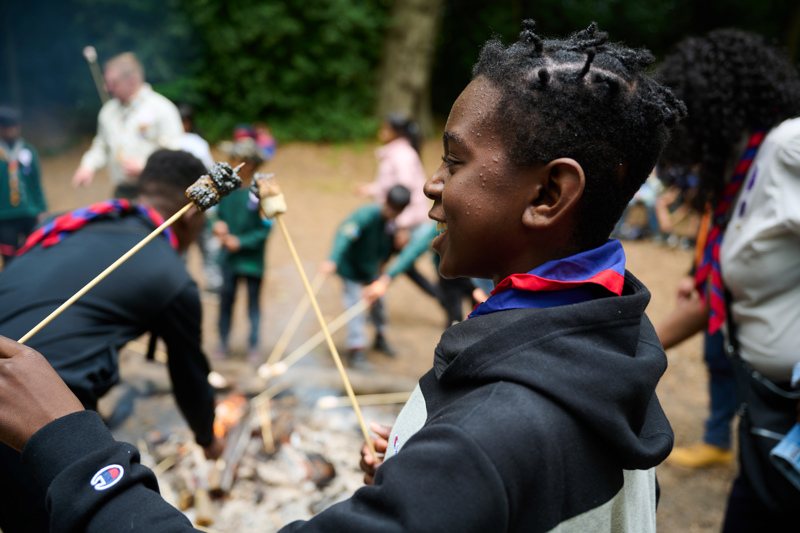
Learn the classic campfire songs - or find some new ones to add to your sing-a-long!