
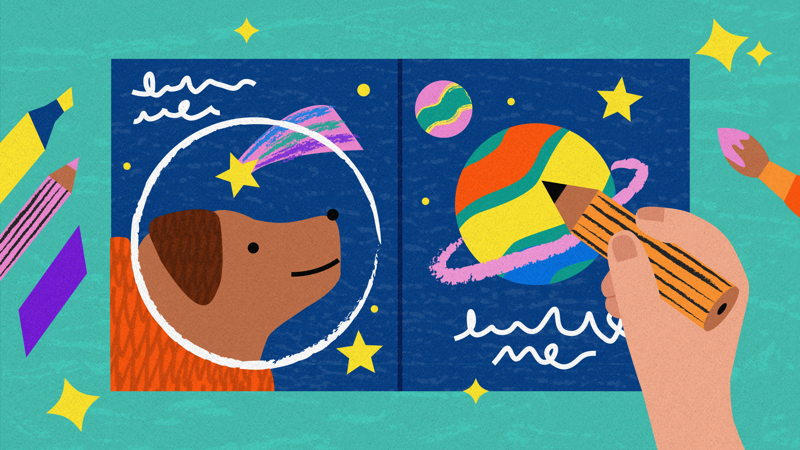
Make a cosmic comic book
You’ll need
- Pens
- Paper
- Comic book templates
- Card
- Craft materials
- Glue
Before you begin
- Use the safety checklist to help you plan and risk assess your activity. There's also more guidance to help you carry out your risk assessment, including examples.
- Make sure all young people and adults involved in the activity know how to take part safely.
- Make sure you’ll have enough adult helpers. You may need some parents and carers to help.
Planning and setting up the activity
- You may wish to have some examples of space themed stories or print comic-book layout templates for people to use.
- Everyone may want to do their own research, so have materials they can use, such as devices with internet access, printed copies of stories, books, articles and other resources.
- Have lots of different craft materials available, such as tissue paper, stickers or collaging materials.
- Depending on what works best for people, they could work in groups and do a page each, or they could also make a comic each.
- If anyone wants to do creative writing, such as a short story, or write a poem instead, that’s OK. Everyone should create something that they want to do and means something to them.
Running the activity
- Gather everyone together and ask everyone what they know about space. You could share a story about a recent space mission or a famous astronaut’s journey.
- Explain to everyone that they’re going to create a comic book that’s themed around space exploration. It should be at least one page. They could make it fictional, or they could tell a factual (non-fiction) story, such as:
-
- First Dog in Space: In 1957, the Soviet Union sent Laika, a stray dog, into orbit on Sputnik 2. Her mission paved the way for human spaceflight, proving that living beings could survive in space.
- Britain’s First Astronaut: In 1991, Helen Sharman became the first British astronaut, flying to the Soviet Mir space station. She was picked from 13,000 applicants and spent 8 days in space.
- The UK’s Mission to Mars: In 2003, the UK sent Beagle 2 to Mars to search for life. It was lost on arrival, but years later, scientists found it had landed successfully, proving British engineering had reached another planet.
- Apollo 13’s Safe Return: In 1970, an explosion on Apollo 13 put the crew in danger. NASA and the astronauts worked together, using only what they had onboard, and against all odds, they made it home safely.
- Katherine Johnson, NASA’s Human Computer: A brilliant mathematician, Katherine Johnson calculated flight paths for Apollo missions, including Apollo 11’s Moon landing. Her work was key to space travel, yet she was overlooked for decades.
- Margaret Hamilton, The Woman Who Put Men on the Moon: A software engineer at NASA, Margaret Hamilton wrote the code that guided Apollo 11 to a safe Moon landing, preventing a last-minute computer crash.
- The Space Billionaire You Don’t Know: UK entrepreneur Richard Garriott paid $30 million to fly to the International Space Station in 2008. He filmed the first sci-fi movie in space and even smuggled bacteria to test how life survives in orbit!
- The Astronaut Who Ran a Marathon in Space: UK astronaut Tim Peake ran the London Marathon while aboard the International Space Station, using a treadmill and a harness to keep himself in place.
- The Girl Who Sent a Message to Aliens: In 1977, NASA launched the Golden Record, a message to aliens with sounds from Earth. Among them was the laughter of a young British girl, meaning extraterrestrials might hear a UK accent first.
- The Space Selfie That Took 12 Years: A British astronaut sent a camera into space in 2003, hoping for a selfie. It crashed back to Earth in 2015—12 years later—and the photos survived.
- The First DJ in Space: In 2016, UK astronaut Tim Peake became the first person to DJ from space, playing a live set for a club in Ibiza while orbiting Earth at 17,000 mph.
- If you’re making a fictional story, you could ask people questions to help them think about their story. Some question prompts might be:
-
- Setting: Where does the story take place? It could be on the International Space Station, on a rocket, on a planet, floating in space or on Earth.
- Characters: Who are the characters? They could be robots, astronauts, humans from the future or aliens.
- Plot: What happens in the story? It could be a space mission gone wrong, an alien encounter, something landing on Earth or a journey through unknown galaxies.
- Feelings: How do the characters feel? They could be happy, curious, excited, scared, brave, lonely, hopeful or sad.
- Now, give everyone time to create their comic. You may wish to run this activity over several weeks.
- If it’s a single sheet of paper, you may wish to glue it onto card.
- Once everyone’s finished, you can share the final pieces. Someone could read their work aloud, or you could put them all together into one big comic book and make copies for everyone. Make sure to check that everyone’s happy with their work being shared and there’s no personal details that can be seen.
Reflection
This activity was all about being creative and sharing stories about space. You had to create a comic book or a similar piece of creative writing. What did you choose to create? Did you make it factual or fictional, and why? If it’s factual, what did you choose to share and why? How did you turn it into a story? If it was fictional, did anything inspire your ideas? Did you think about the beginning, middle or end? What did you enjoy about this task? What do you like about your final piece? What might you do differently next time?
Safety
All activities must be safely managed. You must complete a thorough risk assessment and take appropriate steps to reduce risk. Use the safety checklist to help you plan and risk assess your activity. Always get approval for the activity, and have suitable supervision and an InTouch process.
You must run your activities in line with the Safeguarding Code of Conduct for Adults (Yellow Card) and report any concerns to the UK HQ Safeguarding Team.
To make this activity easier, you could create the story together and each person creates a page of the comic book.
Make it accessible
All Scout activities should be inclusive and accessible.

You could create copies of your comic book to sell to fundraise.
People can create any piece of artwork or writing inspired by space, such as a poem, poster, watercolour sketch or short story.