Learn about light pollution
You’ll need
- Hiking essentials
- Pens and notebooks (optional)
- Camera (optional)
Before You Begin
- Use the safety checklist to help you plan and risk assess your activity. There's also more guidance to help you carry out your risk assessment, including examples.
- Make sure all young people and adults involved in the activity know how to take part safely.
- Make sure you’ll have enough adult helpers. You may need some parents and carers to help.
Planning and setting up this activity
- Choose a clear night when the moon is in its waning phase to make sure the best visibility of stars. You could have devices with star-spotting apps to help with stargazing.
- Use our guidance on night hikes to help run this activity. Make sure there’s a safe place at each destination where the group can stop to look at the stars.
- Everyone should wear warm, weather-appropriate clothing, sturdy footwear, and bring water, spare warm clothing, snacks and torches. You may wish to bring something to sit on.
- It’s best to run this activity over two weeks, with one week for planning and the other week to go on the walk.
- Prepare and bring a first aid kit and explain basic first aid knowledge with the group before the walk. You may wish to do our Emergency Aid badges.
- Make sure all participants know the route and have a phone with a fully charged battery for emergencies.
Running this activity
- Gather everyone together and explain that you're going to study light pollution.
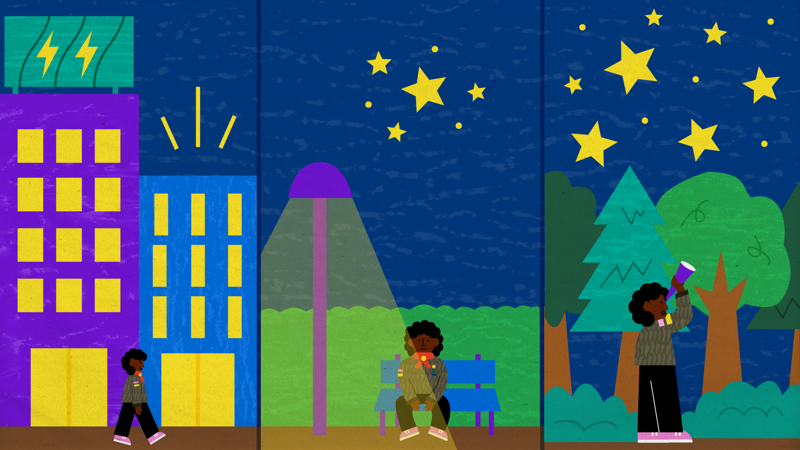
- Explain what light pollution is. Light pollution’s a problem in big towns and cities. It's caused by lampposts, buildings and cars. The light they produce makes it difficult to see stars. A study has found light pollution has increased by about 10% every year since 2011. Scientists say this means that if someone can see 250 stars from a particular location, they'll see fewer than 100 if they stand on the same spot 18 years later. (Source: BBC Newsround, 2023)
- Ask if anyone can think of what or who might be impacted by light pollution. It can affect human sleep and health, change nocturnal animals’ behaviour, confuse insects that pollinate plants, and even make trees in bright areas open their buds to a week early. (Source: BBC Newsround, 2019)
- In small groups study the light pollution maps for your area. You may wish to have copies of light pollution maps for your area or have devices with access to light pollution maps, such as Go Stargazing’s light pollution map.
- Each group should identify:
- Somewhere that has lots of light pollution
- Somewhere that has some light pollution
- Somewhere that has little light pollution
- Now, each group should try to plan a route between these three areas that you can use to travel between them easily. They may need to change which areas they’ve selected.
- Gather everyone back together and ask each group to share their chosen locations, the reasons why and the route between them.
- The group should then choose or vote on one route to use to study light pollution.
- Next, ask each group to predict how many stars you’ll see in each area and note them down.
- Before your head out on the walk, you may want to pack a picnic to eat along the way. Each of the small groups could be responsible for a different part of a picnic, or everyone could bring their own snacks.
- Head out on your walk. Stop for at least 10 minutes at each of the spots you’ve identified.
- Each group should count the stars they can spot. You could even note down any constellations or any causes of light pollution they can find in the area.
- At each stop, everyone can tuck into the picnic or snacks as you’re stargazing.
- At the end, gather everyone back together and discuss what you found. Think about what you predicted, if there were any surprises, and if there were any ways that they thought that light pollution could be reduced in some areas.
- If you want to, you could do this again on another night and compare the results. You could also act on light pollution, such as asking businesses to reduce the lighting or reminding people to turn lights off when not in use.
Reflection
This activity was all about light pollution. Were your predictions about the number of visible stars in each area accurate, or were there any surprises? It’s interesting to think about how much of a difference light pollution can make. How did the level of light pollution affect your ability to see the night sky? What other impacts might it have on people, animals and the environment, and could you spot any signs of these?
You may have noticed patterns in where light pollution was strongest or weakest—what do you think caused these differences? And what actions do you think you or the wider community could take to help reduce light pollution? Even small changes, such as turning off unnecessary lights, can make a difference.
Safety
All activities must be safely managed. You must complete a thorough risk assessment and take appropriate steps to reduce risk. Use the safety checklist to help you plan and risk assess your activity. Always get approval for the activity, and have suitable supervision and an InTouch process.
You must run your activities in line with the Safeguarding Code of Conduct for Adults (Yellow Card) and report any concerns to the UK HQ Safeguarding Team.
- Hiking and walking
Follow the guidance for activities in Terrain Zero, or the guidance from our adventurous activity pages.
- Outdoor activities
You must have permission to use the location. Always check the weather forecast, and inform parents and carers of any change in venue.
- Road safety
Manage groups carefully when near or on roads. Consider adult supervision and additional equipment (such as lights and high visibility clothing) in your risk assessment.
- Visits away from your meeting place
Complete a thorough risk assessment and include hazards, such as roads, woodland, plants, animals, and bodies of water (for example, rivers, ponds, lakes, and seas). You’ll probably need more adult helpers than usual. Your risk assessment should include how many adults you need. The young people to adult ratios are a minimum requirement. When you do your risk assessment, you might decide that you need more adults than the ratio specifies. Think about extra equipment that you may need to take with you, such as high visibility clothing, a first aid kit, water, and waterproofs. Throughout the activity, watch out for changes in the weather and do regular headcounts.
- Dark
Provide some light, so the environment isn’t completely dark. Everyone must be able to see others and move around the area safely.
- Some people might need a screen reader or other assistance when using devices, such as tablets. Digital accessibility tools, such as larger text, magnification, or text-to-speech features, can also be useful. Some people may prefer to use printed versions. For printed resources, some people may need to use magnifying glasses, braille versions or large print versions. Make sure to use colours that can easily be identified for anyone who’s colourblind.
- Make sure the location you visit, route you take and any equipment is accessible for everyone. For example, you may need to consider wheelchair suitable pathways, allergies, avoiding steps, public transport access or planning frequent breaks. Forests and woodlands with well-maintained footpaths or purpose-built roads may be more accessible than wild land. The best way to know if the site is accessible for the needs of your group is to visit beforehand. If you’re unable to visit, ask the land manager any questions in advance. You could visit the area before the session and remove or cordon off any large or obvious obstacles.
- Check for allergies or dietary needs and adjust ingredients if needed. Use separate tools, such as chopping boards, toasters, and tongs, to avoid cross-contamination. Check with parents or carers, and keep any packaging for them to check.
- Some people may find eating difficult for different reasons, such as sensory sensitivities, eating disorders, food preferences, or fasting. The National Autistic Society has helpful guidance on some common food issues. It’s OK if someone doesn’t like or want to try certain foods—offer alternatives but never force them.
All Scout activities should be inclusive and accessible.
If you enjoyed this activity, try some of our other space themed activities.