DIY soil-free plants in a bottle
You’ll need
- Empty plastic bottles
- Scissors
- Cotton wool
- Plant food
- Water
- Small plant seeds, such as lettuce, herbs or other fast-growing plants
Before you begin
- Use the safety checklist to help you plan and risk assess your activity. There’s also more guidance to help you carry out your risk assessment, including examples.
- Make sure all young people and adults involved in the activity know how to take part safely.
- Make sure you’ll have enough adult helpers. You may need some parents and carers to help.
Planning and setting up this activity
- Ask everyone in plenty of time to bring their own suitable bottle.
- Make sure to protect any surfaces, such as with tablecloths or newspapers. You may also want to run this activity outside.
Running this activity
- Gather everyone together and explain what hydroponics is. Hydroponics involves growing plants in a porous material (other than soil) and allowing water containing nutrients to filter through it (Source: BBC Bitesize, 2025).
- Tell everyone that watering plants in zero-gravity is difficult for lots of different reasons. Researchers have also discovered that plant roots grow differently in space, due to the lack of gravity, making watering more difficult. Astronauts can't use a watering can like here on Earth, as the water would just float away. Instead, astronauts use a syringe to inject water directly into ‘plant pillows’ (special bags that contain seed and fertiliser) which are put into the Vegetable Production System (known as Veggie). Since 2014, astronauts on board the International Space Station (ISS) have had a special ‘Veggie’ garden and have managed to grow everything from lettuce to radishes to flowers, with varying degrees of success (Source: BBC Bitesize, 2025).
- Now, it’s time to make the soil-free bottle planter.
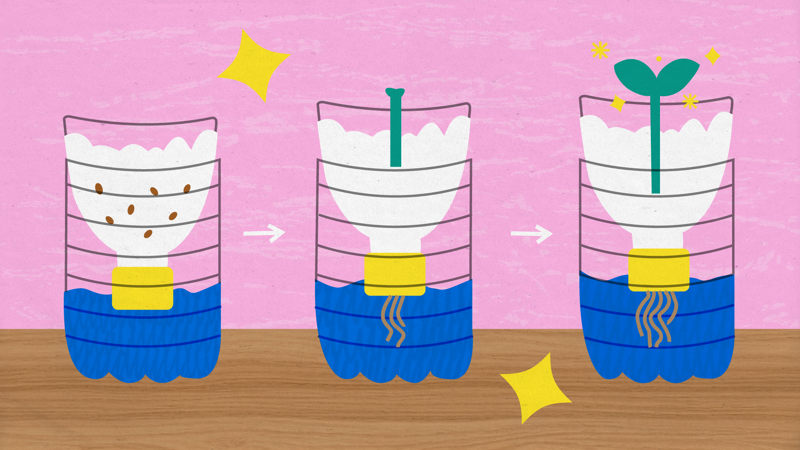
- First, remove the lid and carefully (with adult supervision) cut the bottle in half around the middle. Be careful of hands and fingers when cutting.
- Next, place the top half of the bottle (the lid-end) into the bottom half of the bottle, with the lid end pointing down.
- Add a layer of cotton wool onto the base of the top part of the bottle. This acts as a base for the plant roots to grow into and helps absorb water. Make sure the cotton wool’s thick enough to support the seeds and water but will still allow the roots to grow.
- Gently press several seeds into small holes made in the cotton wool.
- Remove the top half of the bottle.
- Mark a line on the bottom bottle around 3-5cm from the base.
- Fill the bottle with water up to this line.
- Next, mix the plant food following manufacturer’s guidelines and add to the bottom part of the bottle.
- Place the top half of the bottle back onto the base and wash your hands thoroughly after handling plant food.
- Place the bottle in an area with lots of natural light. The water will rise through the cotton wool to water the seeds.
- Check the hydroponic system every day and add more water as needed if the cotton wool dries out.
Reflection
This activity was all about growing plants without soil (hydroponics) in space, and why gardening is important to space exploration. What would happen if we tried to grow plants in space without hydroponics? How do astronauts take care of plants if they don't have soil?
Growing plants in space helps us to see if it would be sustainable to grow food in space, such as for astronauts. What do you think are the other challenges of growing plants in space?
You also made a soil-free bottle planter. What was challenging? Do you think your seeds will grow? How will you look after them?
Safety
All activities must be safely managed. You must complete a thorough risk assessment and take appropriate steps to reduce risk. Use the safety checklist to help you plan and risk assess your activity. Always get approval for the activity, and have suitable supervision and an InTouch process.
You must run your activities in line with the Safeguarding Code of Conduct for Adults (Yellow Card) and report any concerns to the UK HQ Safeguarding Team.
- Scissors
Supervise young people appropriately when they’re using scissors. Store all sharp objects securely, out of the reach of young people.
- Science
Supervise young people, and only do science activities that are advised and age appropriate for your section. Test activities first, to make sure you’re confident you can lead them safely. Use protective clothing where necessary.
- Sharp objects
Teach young people how to use sharp objects safely. Supervise them appropriately throughout. Store all sharp objects securely, out of the reach of young people.
- Craft: Unusual substances
Supervise young people appropriately when they’re using unusual substances, such as powdered paint, ash or dirt. Be aware of any medical conditions that could be affected by what’s being used. Make sure you follow all relevant safety guidance or manufacturers guidelines, where available. Make sure you dispose of it appropriately too, in line with safety guidance.
- Chemicals
This task involves the use of potentially harmful fluids or chemicals. Make sure you follow all relevant safety guidance. Make sure you dispose of them appropriately too, in line with safety guidance.
- Manufacturer’s guidelines
All vehicles will be different so always follow the manufacturer’s guidelines.
- Make sure that all the tasks are safe and achievable for everyone. Consider if any parts can be pre-done (such as cutting the bottles) and have adapted, easy-to-use tools and left-handed equipment available if needed. You could offer examples or templates to support people with the make or give a demonstration of what to do.
- Anyone who struggles with measuring can work with a friend, a young leader or volunteer, or in a group. You can clearly mark the required lengths on a tape measure or ruler, such as with coloured tape, to make it easier.
- This activity can be done standing or sitting, with those sitting either on the floor or on chairs.
- Accessible tools for gardening are available, such as left-handed tools or funnels for pouring soil or seeds. People could work with a friend, an adult or with a group. For example, if they may need someone to hold the plant pot while they pour soil in.
- Some people might not like how it feels to touch some materials or the different textures, such as soil, or they may not like getting messy. No-one should be forced to touch something they feel uncomfortable with. They could wear gloves, work with someone else, find another way to do the activity, or use tools to help them (such as trowels).
- Always check for allergies when gardening, such as peanut shells in compost, then adapt what you use as needed. This may include making sure no-one at home has a relevant allergy if the item will be taken home.
All Scout activities should be inclusive and accessible.
If you enjoyed this activity, try some of our other space themed activities.