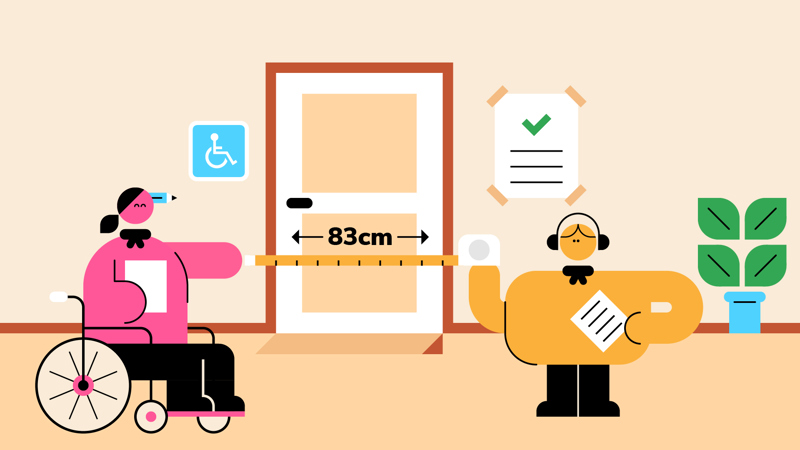
Discover how accessible your meeting place is
You’ll need
- Pens or pencils
- Sticky notes
Before you begin
- Use the safety checklist to help you plan and risk assess your activity. Additional help to carry out your risk assessment, including examples can be found here. Don’t forget to make sure all young people and adults involved in the activity know how to take part safely.
- Make sure you’ll have enough adult helpers. You may need some parents and carers to help if you’re short on helpers.
Planning and setting up this activity
- You can find guidance on creating Scout spaces that are more accessible for disabled people in our Accessible Spaces Checklist.
- You could also use this activity to explore accessibility at another place, such as a library or community centre. Make sure you get permission for your visit, and make sure you ask before sticking sticky notes around!
- If anyone in the group has lived experience of disability, they could share their story if they feel comfortable to. It’s important that no one’s made to share anything they don’t want to, and no one should talk about someone else’s disability unless that person says it’s okay. All discussions should respect people’s privacy, and a person’s disability should never be disclosed without their direct consent. You may wish to tell everyone about the topic in advance of the session.
- You may need to offer reassurance to anyone who may find this topic difficult. Remember to always follow the Yellow Card.
- Find out more about young carers and disability inclusion in Scouts.
At Scouts, we follow the social model of disability. The social model of disability is a way of viewing the world, developed by disabled people. The model says that people are disabled by barriers in society, not by their impairment or difference. Barriers can be physical, such as buildings not having accessible toilets or not having access to an BSL interpreter. Or they can be caused by people's attitudes to difference, such as people assuming disabled people can't do certain things.
The social model helps us recognise barriers that make life harder for disabled people. Removing these barriers creates equality and offers disabled people more independence, choice and control.
You can find out more about the social model of disability on Scope's website.
Remember, although we'll use certain wording, in-line with the social model, it'll vary from person to person on how people view or describe their own disabilities. It's important to take the person's lead, and use the words that they use if you're having a conversation about disability.
Run the activity
- Gather everyone together and explain that you'll all be looking at how accessible and inclusive your meeting place is.
- Divide everyone into small teams.
- Give each team an 'Accessibility checklist', some pens and some sticky notes.
- Each group should use their checklist to explore their meeting place and figure out just how accessible it is. This checklist focuses on physical disability, for example, people who use wheelchairs or who find walking difficult. However, you may want to ask people to also consider how you could make the meeting place accessible for non-physical disabilities, invisible disabilities and those who are neurodivergent.
- Groups should use the checklist to help them explore their meeting place. They could stick sticky notes on any areas they find which are not accessible.
- Where the answer to a question is ‘no’, they should talk about what could be done to make it better. There’s space for them to write their ideas down, if they want to.
- Everyone should gather back together as a group.
- Ask everyone what they found. Did they all find the same things?
- Ask people to share their ideas for making it better. As a group, could you do anything about any of those ideas?
- Ask if anyone could think of (or find) anything that wasn’t on their checklist.
Reflection
This activity helped you to respect others. Why is it important that spaces such as your meeting place are accessible? Why is it important that everyone can access spaces? Were you surprised at what you found? Do you think we can respect people if we don’t also make an effort to include them?
This activity also gave you the chance to care. How do you think it would feel for someone who isn’t able to join in with everything because your meeting place isn’t accessible? How do you think it feels if lots of the world isn’t accessible? How do you think it feels when people have already thought about access, and made sure you can take part? What can we do to make sure disabled people aren’t excluded?
Safety
All activities must be safely managed. You must complete a thorough risk assessment and take appropriate steps to reduce risk. Use the safety checklist to help you plan and risk assess your activity. Always get approval for the activity, and have suitable supervision and an InTouch process.
You must run your activities in line with the Safeguarding Code of Conduct for Adults (Yellow Card) and report any concerns to the UK HQ Safeguarding Team.
- Visits away from your meeting place
Complete a thorough risk assessment and include hazards, such as roads, woodland, plants, animals, and bodies of water (for example, rivers, ponds, lakes, and seas). You’ll probably need more adult helpers than usual. Your risk assessment should include how many adults you need. The young people to adult ratios are a minimum requirement. When you do your risk assessment, you might decide that you need more adults than the ratio specifies. Think about extra equipment that you may need to take with you, such as high visibility clothing, a first aid kit, water, and waterproofs. Throughout the activity, watch out for changes in the weather and do regular headcounts.
- Give each group sticky notes to label activities.
- Think about other accessibility issues – does noise echo in any of the rooms? Are the rooms well-lit, but not too bright? Are things clearly signposted with pictures or symbols as well as words?
- Take action on accessibility issues – is there anything you can do to improve the accessibility of your meeting place? It might be as simple as making sure the red cord in the toilet is loose and dangling, or changing a lightbulb – but sometimes we need to take bigger actions, like writing letters to the people in charge of the building.
If anyone has any physical accessibility requirements, they’ll be the expert voice in their team! Make sure that they’re able to join in with all of the checklist – the group shouldn’t disappear to an inaccessible area without them.
All Scout activities should be inclusive and accessible.
Bring your ideas on improving accessibility to life. You could draw your new ideas, build some examples from craft materials, or fundraise to make your changes real.
You could work towards your Community Impact Staged Activity Badge by taking action around disability.