Our finances
Contents
- Reflecting on new beginnings
- Refocusing our priorities
- Renewing our promise to help other people
- Our purpose and method
- Skills for Life: Our plan to prepare better futures 2018-2025
- Growth
- Inclusivity
- Youth shaped
- Community impact
- Three pillars of work
- Youth programme
- Volunteering
- Perception
- The impact of Scouts on young people
- Keeping young people safe
- Safeguarding
- Fundraising
- Our finances
- Trustees' responsibilities
- Independent Auditor’s Report to the Trustees of The Scout Association
- Consolidated statement of financial activities
- Balance sheet
- Statement of cash flows
- Notes to the financial statements
- Our members
- How we operate
- Governance structure and Board membership – 1 April 2024 to 31 March 2025
- Our thanks
- Investors in People
Our finances
Overview
Scouts is pleased to share that, as of 31 March 2025, our balance sheet remains strong. This is despite a £3.1m reduction (2023-24: £4.1m reduction) in our total funds from £82.5m to £79.4m arising from a net deficit on unrestricted funds of £5.7m, partially off-set by an increase in restricted funds of £2.6m. Looking forward, our focus is on containing the unrestricted deficit for the year to March 2026 within the £2.5m budget set by the Board, while also meeting their challenge to achieve a break-even position, or better, for the year to March 2027 and beyond.
For the purposes of this report, we have excluded any jamboree income and expenditure, as referenced throughout, to ensure the figures are comparable.
Income
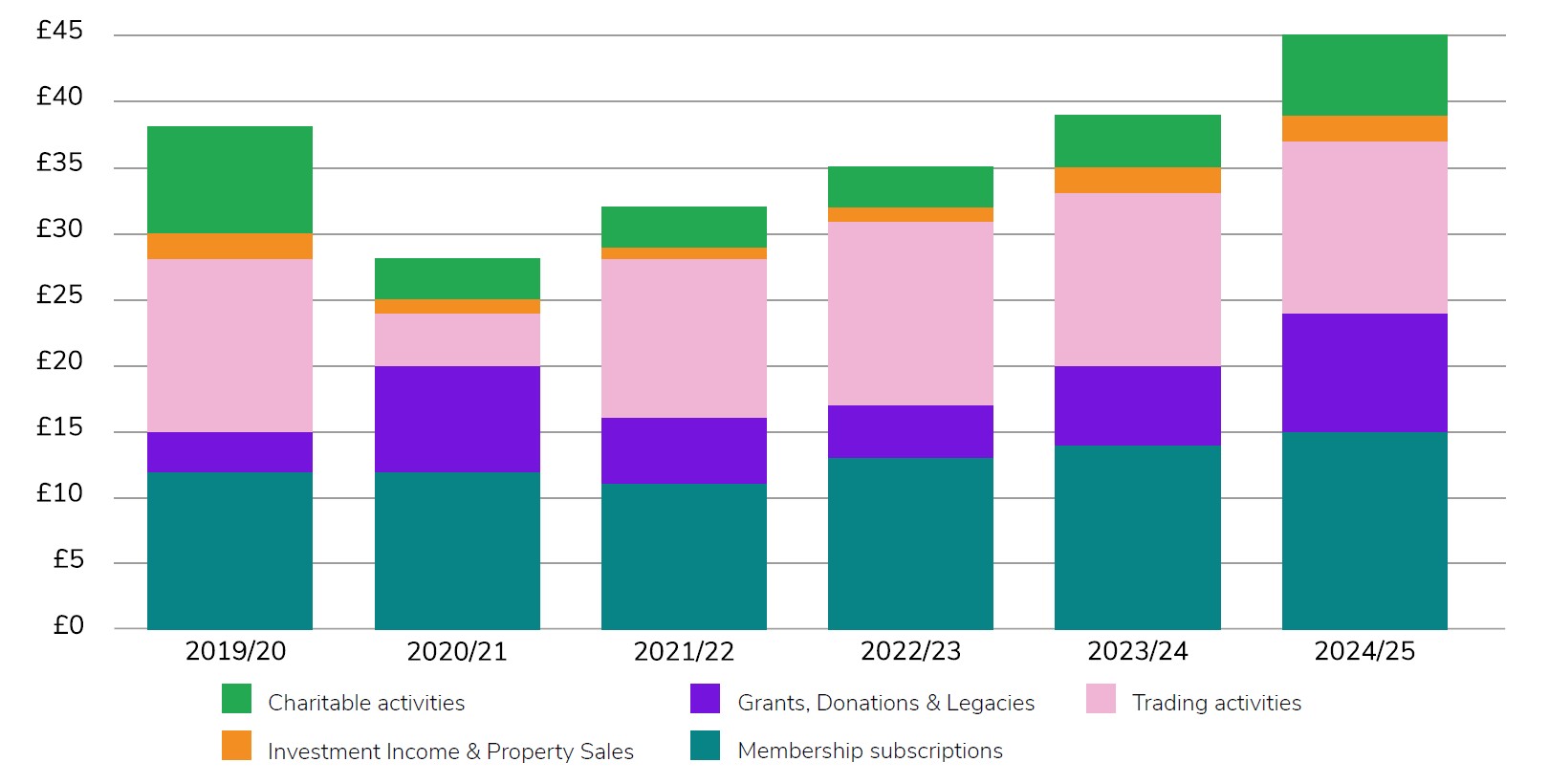
Our total income for the year was £46.9m, compared with £39.6m in the prior year, excluding £14.1m of Jamboree income not repeated in the current year. £38.8m of income was unrestricted (2023-24: £34.8m, excluding the Jamboree) and £8.2m restricted (2023-24: £4.8m).
The unrestricted income included:
- Membership subscriptions of £15.5m (2023-24:£14.3m) reflecting a 2.0% increase in youth membership and a £2 (5.6%) increase in the membership fee.
- Trading income of £12.9m (2023-24: £13.2m), made up of retail sales from Scout Shops, insurance commission income generated by Unity, sponsorship, and promotional income. A decline in uniform and badge sales, combined with a lower-than-expected membership growth during 2024–25, reduced Scout Shop income by £0.7m to £8.9m. At £2.7m, Unity commission income showed a slight increase on the previous year. Income from promotions and sponsorships increased by over 15% to nearly £1.3m.
- Charitable activities income of £6m (2023-24: £4m,excluding the 2023 Jamboree) consists primarily of income from the National Scout Adventure Centres. While the increase year on year is promising, these centres don’t yet show an overall surplus. Their work, however, is continuing to improve our offer both to Scouts and non-Scouts clients.
- £1.2m profit on the sale of Downe Activity Centre.
- Investment income (including interest) of £1.95m,£0.1m down on the previous year due to lower cash and investment balances.
At Scouts, we can’t overstate how much we appreciate the vital and generous support of our donors. In these difficult and uncertain economic times, we’re thrilled that voluntary income at £9.4m was £3.5m up on the previous year. Of this total, unrestricted income was broadly flat at about £1.3m and includes £0.5m from the Postcode Children Trust. Restricted income increased by about £3.5m, largely due to the donation from Omaze to fund the growth and development of Squirrels in future years, as well as £0.7m from Generation Green. We’re also grateful to the Department for Culture, Media & Sport (DCMS) for a grant of £2.8m from their Uniformed Youth Fund to support Local Growth Officers in England, as they continue to open new Scout and Explorer Sections.
Expenditure
Scouts’ total expenditure was £50.6m, compared to £60.2m in 2023–24, which included £16m of spend related to the Jamboree that wasn’t repeated in the current year.
£45.2m of spend was unrestricted (2023-24: £40.0m, excluding the Jamboree) and £5.4m restricted (2023-24: £4.3m) and included:
- Staff costs of £25m. This was up £2.5m over the previous year, due to the full year impact of new roles recruited in 2023–24 and additional roles appointed to deliver key projects in digital transformation, Volunteer Experience, Skills for Life and safety. A number of these roles, particularly across Skills for Life and Volunteer Experience, were fixed term. They came to an end, in stages, in the run up to March2025.
- £1.4m expenditure for continuing investment in new digital tools to support the Volunteer Experience, which went live in late 2024. A further £1.6m of spend was capitalised in the year.
- £2.6m relating to public liability claims and the associated legal costs (2023-24 £2.5m).
- £1.5m (2023–24: £1.3m) of grants to Scouts’ Groups, Districts, Areas, and Counties.
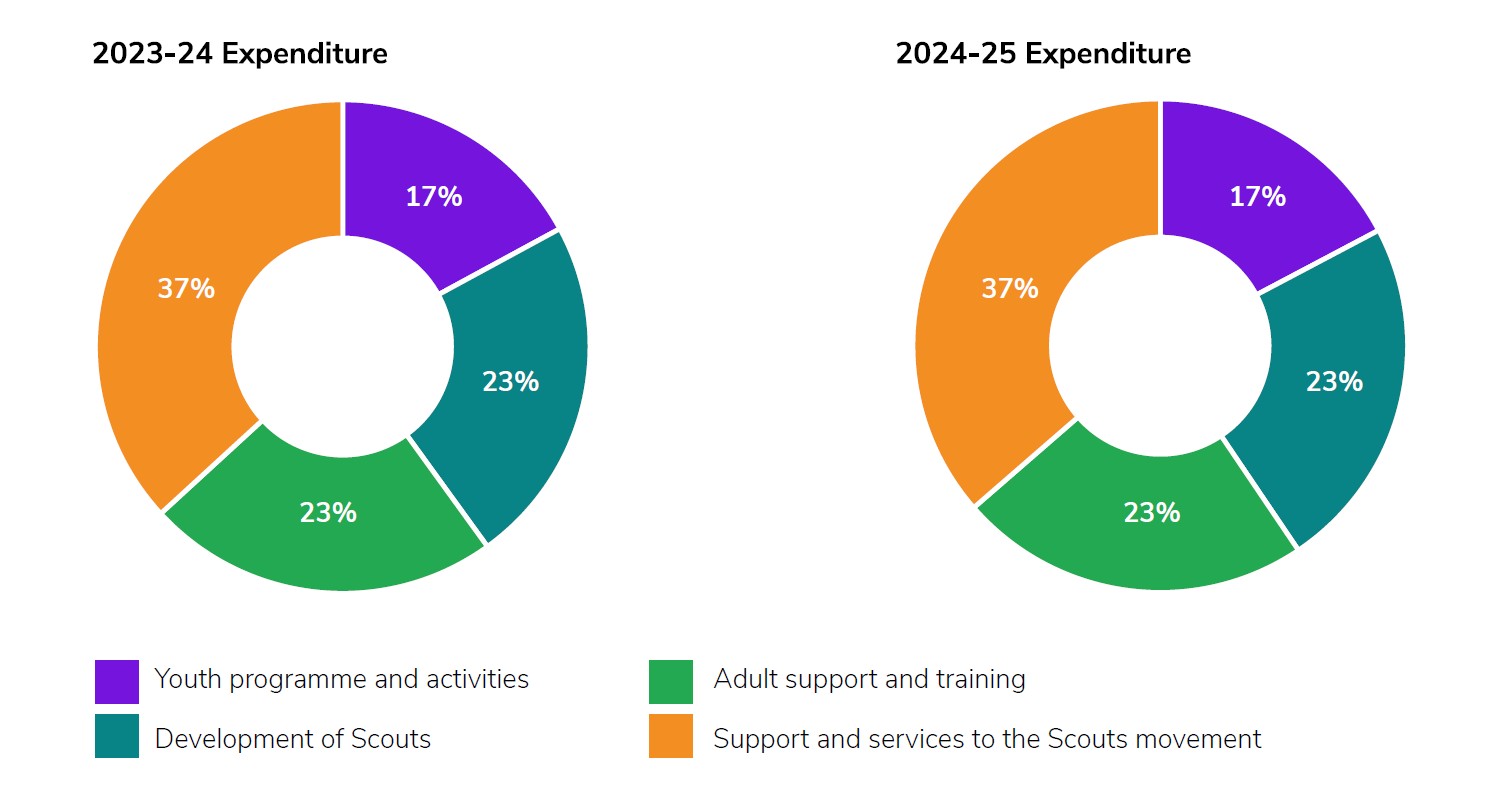
As shown on the pie charts below, we spent £41.6m (2023-24: £34.6m, excluding the Jamboree) on charitable activities. This spend is allocated under four headings, which help Scouts fulfil four strategic objectives (Growth, Inclusivity, Youth Shaped, and Community Impact). £5.4m of costs (2023-24: £4.2m) were funded by restricted funds.
Charity funds
By 31 March 2025, Scouts’ consolidated funds stood at £79.4m, down £3.1m over the previous year. These funds were made up of:
- £2.3m of endowment funds (2023-24: £2.3m) comprising of the 1914 Endowment Fund (£1.1m),£0.9m King George VI Leadership Fund, and six smaller endowments. While capital is preserved, the investment income arising is allocated to either unrestricted or restricted spend depending on the terms of the endowment.
- £6.9m of restricted funds (2023-24: £4.3m) comprising a £3.5m restricted donation from Omaze for spending over the coming years, £0.7m of funds remaining for the ongoing refurbishment of The Welcome Centre, £0.8m of local development funds, and a range of smaller unspent restricted funds.
- £31.5m designated fixed asset fund (2023-24:£29.9m) matched to The Scout Association’s tangible, intangible, and heritage assets. This mainly increased due to the revaluation of Scouts’ heritage assets and the capitalisation of our software development.
- At £2.6m, the pension fund surplus remains broadly unchanged from the prior year.
- General funds reduced by £7m to £35.1m, due to funding the unrestricted deficit for the year plus a£1.2m transfer to the fixed asset fund.
Note 18 in the financial statements, describes all funds in more detail, including an analysis of movements in the review period.
Reserve policy
Every year, the Trustees review our reserve policy. The intention is to hold reserves to protect The Scout Association and its delivery of charitable programmes. The policy is designed to provide Scouts with time to adjust to changing financial (and/or other) conditions.
The reserves policy establishes a target for the level of general ‘free’ reserves, as represented by the balance of the General Fund. This target is based on a risk assessment of the likely financial impact on The Scout Association’s activities, caused by a decline in income, an inability to meet its financial obligations, or an inability to reduce expenditure in the short term. The risk assessment also considers how likely these circumstances are to occur. The policy aims to create a balance between spending the maximum amount of income raised as soon as we receive it, while maintaining an appropriate level of reserves so the charity can operate uninterrupted. It also provides parameters for future budgeting, strategic plans, and decision making.
The COVID-19 pandemic showed how unexpected events can create significant short-term reductions in membership and the associated loss of commercial income while the need to maintain member services remains high. So, our Trustees currently believe that the appropriate target for Scouts’ free reserves should be based on one year’s unrestricted expenditure (excluding one-off, generally self-funded, events such as the Jamboree), with an additional element for possible future claims costs reflecting the longer time frame over which they emerge.
Based on unrestricted charitable expenditure of £36m for the year ending 31 March 2025, plus an assumed £3m for possible future claims, this would indicate a target reserves level in the order of £39m.
As of 31 March 2025, general ‘free’ reserves for the charity stood at £35.1m (2023-24: £42.1m), nearly £3.9m under this target reserves level.
The Trustees have approved an unrestricted budget for 2025–26, which would give a further loss of about £2.5m. It’s, therefore, expected that free reserves will reduce again over the coming 12 months. While Trustees aren’t expecting the free reserves to be replenished to the target level in the short to medium term, they’ve challenged the management team to deliver a break-even (or better) budget for 2026–27 to protect reserves and build a more financially sustainable position into the future. A cost reduction programme is underway, focussed on both staff and non-staff costs, to meet this challenge. This should preserve (or marginally build) reserves next year, and lower the target, through reducing the level of unrestricted expenditure.
Investment policy and performance
The charity holds £35.5m in fixed asset investments. £24.6m are in a longer-term investment portfolio (initially equally allocated between two fund managers), with the balance of £10.9m held in short-term money market funds. Since 2022, the performance targets given to the fund managers for the longer-term portfolios, over the medium to long term, are:
- To maintain an optimum level of income, tempered by the need for capital growth to safeguard future grant-making capacity.
- On a total return basis, to outperform CPI + 4% per annum on a rolling three-year basis.
Neither manager has achieved this target in the period since the portfolios were established in 2022. This isn’t surprising, given the rise in inflation and volatile market conditions over this period. Both, however, are performing broadly in line with benchmarks for similar multi-asset portfolios which have a significant equity component. The Trustees believe that such an asset allocation is still appropriate for assets to be held for the long term, although the performance of the managers is kept under review.

Going concern
The Board has considered the financial plans for the budget year of 2025–26 and projections for the following two years, looking at both cash and reserve projections.
The Board believes that current actions, focused on containing the unrestricted deficit for 2025–26 to within the £2.5m budget set by the Board, and meeting the challenge of a break-even or better unrestricted budget for 2026-27 (through a cost-saving programme), will provide a solid foundation for building a sustainable financial position for the future. The Board’s view is Scouts’ current reserves provide a significant level of resilience towards any possible financial risks that may materialise in the short to medium term.
Taking all the above into account, the Trustees have a reasonable expectation that the charity has the adequate resources to continue operating for the foreseeable future. Accordingly, they believe the ‘going concern’ basis remains the appropriate approach for preparing the financial statements.
The Scout Association Defined Benefit Pension Scheme
The most recent full triennial actuarial valuation of The Scout Association Defined Benefit Scheme was carried out as of 31 March 2022. The valuation resulted in a deficit of £2.5m and a funding level of 94% – an improvement from the 86% funding level at the previous March 2019 valuation. As agreed by the Board, £2.5m was paid in March 2023 to eliminate this deficit. Following this injection and as sanctioned by the Pension Fund Trustees, the scheme has further reduced its exposure to changes in future interest rates and equity markets. As such, the probability of Scouts’ facing prospective liabilities has significantly reduced. That said, the Board continues to monitor the scheme’s funding to make sure general reserves provide adequate cover and keep the potential for effecting an insurance buy-out of the scheme under review.
The accounting FRS102 valuation as of 31 March 2025 shows the fair value of the scheme assets exceeded the present value of future obligations by £2.6m (2023-24: £2.7m). This slight reduction is primarily due to the decline in asset values over the year, largely offset by the decrease in the fund’s liabilities, due to the increase in the discount rate assumption. This comparatively low net variation was as anticipated, given that the fund has taken steps to derisk its overall exposure to economic conditions and in particular interest rates.
Remuneration policy
The Trustees consider that the Board of Trustees and the Executive Leadership Team (the Chief Executive and the Directors) comprise the key management personnel of the Charity.
All Trustees give their time freely, and no Trustee received remuneration in the year. The Chief Executive (who is also a Trustee and a full member of the Board) is paid for his executive duties only.
Details of Trustees’ expenses and senior staff remuneration are contained in notes 6 and 7 to the financial statements.
The remuneration of the senior staff is reviewed annually by the People and Culture Committee (a subcommittee of the Board), considering market conditions, cost of living increases, and the financial position of the organisation. The salaries of the Executive Leadership Team are benchmarked to make sure they’re commensurate with the size of the roles. The Executive Leadership Team members are entitled to employer pension contributions and other benefits that are available to employees generally. In addition, enhanced medical insurance provision is provided for permanent members.
The Executive Leadership Team sets the salaries for all other employees. The remuneration benchmark is the mid-point of the range paid for similar roles, although a market rate supplement may also be paid where appropriate.