Keeping young people safe
Contents
- Reflecting on new beginnings
- Refocusing our priorities
- Renewing our promise to help other people
- Our purpose and method
- Skills for Life: Our plan to prepare better futures 2018-2025
- Growth
- Inclusivity
- Youth shaped
- Community impact
- Three pillars of work
- Youth programme
- Volunteering
- Perception
- The impact of Scouts on young people
- Keeping young people safe
- Safeguarding
- Fundraising
- Our finances
- Trustees' responsibilities
- Independent Auditor’s Report to the Trustees of The Scout Association
- Consolidated statement of financial activities
- Balance sheet
- Statement of cash flows
- Notes to the financial statements
- Our members
- How we operate
- Governance structure and Board membership – 1 April 2024 to 31 March 2025
- Our thanks
- Investors in People
Keeping young people safe
The past year has been one of deep reflection and significant change regarding safety in Scouts. So, in this section, we’re seeking to explain what we’ve learned and how we’ve progressed. This annual review’s more extensive focus on safety should provide the foundation for a dedicated review, solely focused on safety, in the years to come.
What follows is an overview of how Scouts works, regarding safety. It’s designed to help everyone in our movement understand what we all need to do to keep our young people, volunteers, and staff, healthy and safe. Ours is a continuous journey of operational improvement around safety.
A big part of what we’ve learned is to be more open. So, we’re sharing the lessons we’ve learned, the improvements we’ve made, and recognising the work we still need to do.
In April 2024, as part of concluding the inquest into the tragic death of an Explorer Scout, a Prevention of Future Deaths report was published. Scouts accepted HM Coroner’s observations and made a set of commitments.
These commitments included reviewing our safety policies and practices, working with the Royal Society for the Prevention of Accidents (RoSPA), developing and delivering new safety learning for volunteers, reviewing and reflecting on our internal permit schemes for Adventurous Activities and Nights Away, and much more.
Our commitment to improving safety includes increasing our safety related support for the movement. With this in mind, alongside managing safety incidents, our Safety Team has increased site visits, to give their expert ‘on the ground’ support.
The Safety sub-committee of our Board of Trustees, has focused on critical root cause analysis, supported by new members with expertise in equivalently complex settings. Risk considerations are being incorporated into decisions at every level, so a golden thread of safety runs through everything we do.
Aim
- To empower those with operational responsibilities for safety by supporting them as they deliver safe activities for our young people, through new learning, guidance, and support.
- To provide young people with learning opportunities through a wide range of adventurous activities, where risk is appropriately managed.
- To supporting young people, adult volunteers, and staff as they develop their understanding of risks and how these can be managed.
To support these aims, Scouts’ National Safety Team, and a growing network of County safety advisors, will offer advice, guidance, information, and training to those in leadership roles.
Goals
By April 2026, we’ll:
- Support those in senior leadership roles as they’re continuously trained in line with the best safety practice standards. This’ll help them to provide the robust oversight needed to continue to lead our movement safely.
- Deliver, and further embed, the changes we’ve made in response to HM Coroners’ Prevention of Future Deaths (PFD) Report.
- Review and strengthen Scouts’ safety management system, considering the learning we’ve gained from external reviews, reports, and the varied experiences of our movement.
- Support our leaders, volunteers, and staff as they empower young people (and those they influence) to make sound risk-based choices.
- Help young people, as part of their experience in our programme, to make good risk-based decisions.
- Establish an enhanced approach to assurance.
Progress a year on
Our progress and learning this year has been strongly shaped by our 24 commitments responding to the observations made by HM Coroner, following the inquest into the tragic death of an Explorer Scout. These commitments included promising to openly share our progress. Full quarterly reports, including the lessons we’ve learned and the actions we’ve taken, are available on scouts.org.uk.
- Safety through our governance: Scouts introduced a series of new governance approaches including a dedicated sub-group of our Trustee Board, led by our Chair, to oversee the delivery of our commitments. This involved engagement across our movement, sharing the changes we planned to make and the reasons behind them.
- We developed and adopted a new Duty of Candour Policy, which was approved and implemented by our Board of Trustees from July 2024.
- Scouts developed new policy and procedures for how we manage critical incidents, for testing and adoption in summer 2025.
- We made sure our Safety Policy was externally reviewed. This process shows our commitment to safety and underlines the expectation that everyone in Scouts plays their part in keeping young people safe.
- We added to our Safety Committee’s capabilities by recruiting two new independent members. Their role is to scrutinise and challenge our movement’s actions on safety.
- The addition of these new members, with their strong credentials in complex safety environments, significantly enhances the committee’s expertise.
- Scouts appointed the first UK Lead Volunteer with a focus on safety to complement the professional safety expertise of the staff team.
- We increased our investment in a national support network for volunteers, including a staff Safety Team that works in partnership with volunteers; with oversight from the Safety Committee. Together, they’re establishing clearer governance pathways for direction setting, assurance, and leadership. This clarity of communication is essential as we continue to transform how we progress our safety practices.
External review and scrutiny
- Scouts appointed a panel, with strong credentials in senior investigatory and safety work, to complete a Fatal Accident Investigation into an Explorer Scout’s tragic death in 2018. We accepted all findings from the first phase of the investigation. We’re implementing the panel’s recommendations and learnings across our movement. We’ve since commissioned this independent panel to undertake a review of the key decisions made by Scouts directly following the tragedy.
- We established a relationship with The Royal Society for the Prevention of Accidents (RoSPA) who supported us with:
- A review of policies, procedures, and arrangements within Scouts, including the annual review of our Safety Policy.
- A training needs analysis, aligned to our volunteer roles and ways of working.
- New Safety Learning for our volunteer base, developed with (and assured by) RoSPA Qualifications.
- Requiring all our volunteers to complete additional safety training. We’re giving support to volunteers so they can complete this training by 14 July 2025.
- We commissioned independent experts Adventure Risk Management Services (Adventure RMS) to review our Adventurous Activity Permit Scheme, assessing its design, standards, and regulatory engagement. A formal response to these findings will be submitted to the Safety Committee in summer 2025.
Supporting our movement
The Safety Team gives advice and guidance across our movement, comprising staff and volunteers.
- They’ve run training weekends around key activities, Nights Away, and permits. Following positive feedback, more of these weekends are planned for the year ahead.
- They’ve made some initial, proactive, on-site risk-based visits offering more direct support for volunteers.
- They’ve delivered internal reviews of safety guidance and began offering more support at key events for our movement.
- They’ve enhanced the approach to First Aid training and support, clarifying the use of external qualifications.
- They’ve given clarity about restrictions for those involved in critical incidents or significant near misses, making sure Scouts provides adequate support and is effectively managing risk.
- They’ve established a new approach to reviewing risk and compliance throughout the movement with dedicated staff support. This was informed by team site visits and has included engaging with a substantial number of volunteers across our movement to assess and support compliance within five core control areas: Nights Away, Training, Safety, Visits Abroad, and Adventurous Activities.
- They’ve taken the first step to rebuilding our volunteer Adventurous Activities team, as a core part of what young people experience in our programme.
Reporting and insights
Through the year, there’s been an increase in the number of safety incidents and ‘near misses’ reported into the National Safety Team. We believe this correlates with increasing awareness of safety reporting arrangements as we increased communication about safety as part of our ongoing commitments.
A slight increase in critical incidents may indicate the impact of revising internal definitions, and improved reporting as a result.

The spread of incidents by membership type broadly follows the trends of previous years. There’s some variation for Explorer Scouts which relates to the impact, in the previous reporting period, of the 25th World Scout Jamboree in South Korea.
- The distribution of incidents by activity type and injury type is maintained from the previous period.

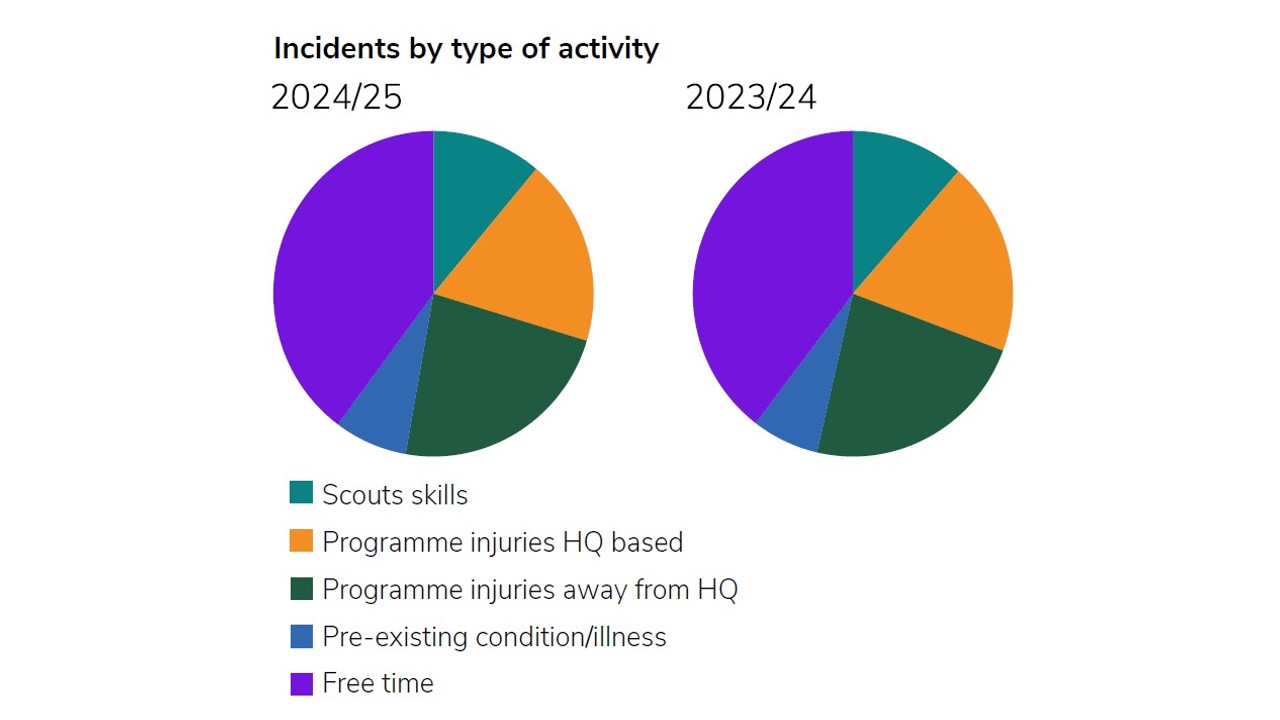
- 2,332 incidents were reported in total, with more incidents during the summer season (May to September), which is in line with when the movement is more active and outdoors.

- 654 incidents were recorded in ‘free time’.
- The most common cause of incidents is ‘a slip, trip or fall’ at 43% or 1,012 incidents.

- The next most common issue is ‘contact with something’ at 540 incidents.
- ‘Health-related’ incidents make up 347.
These top three causes account for 82% of reported incidents and we’ll focus on these areas in the coming year.
Learning and reflection
During the reporting period one National Learning review was considered by the Safety Committee which related to an adult volunteer who suffered serious injuries following an abseiling incident. Learnings from this and other reported incidents are published on Scouts website to make sure learning is shared openly with the movement. Learnings which led us to change our approach or processes have included:
- A ban on using Trotti bikes following an incident overseas. Investigations determined brakes are orientated differently in mainland Europe compared to UK cycles. This, combined with the potential for further incidents, meant the Safety Committee ratified the unusual decision to stop this activity.
- The importance of applying robust risk assessment principles, including how to implement dynamic risk assessment, has been incorporated into the mandatory training designed in this period and supported by RoSPA.
- The importance of communicating with parents and carers, in a clear, emphatic way, about any serious incidents. This comes from our adoption of the Duty of Candour Policy and the new ways of working it requires.
Actions and mitigations against key risks
- Scouts continues to review its approaches to risk. We’ve instituted external assurance to make sure we’re complying with legal requirements and expected organisational arrangements for safety. We’ve instigated a process for rapid assurance which was prioritised by the Board of Trustees and Safety Committee.
- In regard to communicating changes and updates effectively across the movement, we’ve updated our approach to both safety learning and communications. This means members, via our website, are given regular updates and can learn from key safety–related incidents.
- Regarding insufficient national resourcing to proactively offer support to the movement, Scouts continues to expand its Safety Team, across staff and volunteers, so that it can investigate all reported incidents. The team has begun to look at proactive projects where there are opportunities to make sure approaches are more robust with the aim of preventing incidents.
- In regard to the challenges specific to our federated structure and joint leadership approaches, these have been mitigated through closer scrutiny from the Safety Committee. The Safety Team continues to build relationships to strengthen our approach. For example, the way the Safety Team has worked with Adventurous Activities has given us a model that can be reproduced elsewhere.
- Regarding so-called ‘Unknown unknowns’, in respect of our approach and general policies, Scouts commissioned a series of external reports. We’re currently working through their recommendations at pace.
Learning supported by partnership
Over the past 12 months, we’ve worked with a considerable number of external partners and organisations, whose expertise has supported our learning and development of safety. The following deserve a special mention:
- The Royal Society for the Prevention of Accidents (RoSPA) for their independent expertise as leaders in the safety sector.
- Royal National Lifeboat Institution (RNLI), who continue to share vital learning with us.
- The Voluntary and Community Sector Emergencies Partnership (VCSEP).
- Essex County Fire and Rescue Service.
- Adventure Risk Management Services (Adventure RMS) who’ve worked with Scouts this year as we examine specific elements of what we do, such as the Adventurous Activity Permit Scheme.
- Independent members of the Fatal Accident Investigation Panel for the diligence they showed in their investigation into the tragic death of an Explorer Scout.
- Our Primary Authority partner, for their continued hard work and dedication to our movement.
What's next
Scouts will continue to invest in safety, putting it at the heart of all we do. We’re passionate about building our collective capability to deliver safe and meaningful learning for young people.
Specifically, we’ll:
- Keep seeking input from independent experts as we drive transparent, continuous, improvement in Scouts’ safety practices.
- Review and learn from the recommendations in independent reports and movement consultation, while continuing to deliver on all our PFD commitments.
- Refine our policies and practices around safety. We’ll make changes in our approach to risk assessment, as highlighted by RoSPA’s review, and develop the Adventurous Activities Permit Scheme in response to the independent review by Adventure RMS.
- Review our approach to incident management, making it easier for teams to report incidents and provide helpful insights to leaders. We’ll use this data to improve arrangements and support learning.
- Make sure our practices are fit for purpose and the movement is following them effectively, providing dedicated safety learning for senior volunteers and staff.
- Improve safety management systems and how we provide effective guidance for volunteers.
- Refine how we use data and insights to target our work, focusing on where we can make the greatest impact.
- Support volunteers in involving young people in safety decision making. This’ll make safety and risk more youth shaped and enable young people to develop safety awareness as a skill for life.
- Develop a dedicated annual report focused on safety and what we’re learning. We’ll publish the first report in 2026, which’ll detail Scouts’ progress as a continuation of our commitment to transparency around safety.