11 games to celebrate South Asian Heritage Month
South Asian Heritage Month celebrates the history and achievements of some of the countries in South Asia - The Maldives, Bangladesh, India, Bhutan, Nepal, Pakistan, Sri Lanka and Afghanistan. It runs between the 18 July and 17 August each year.
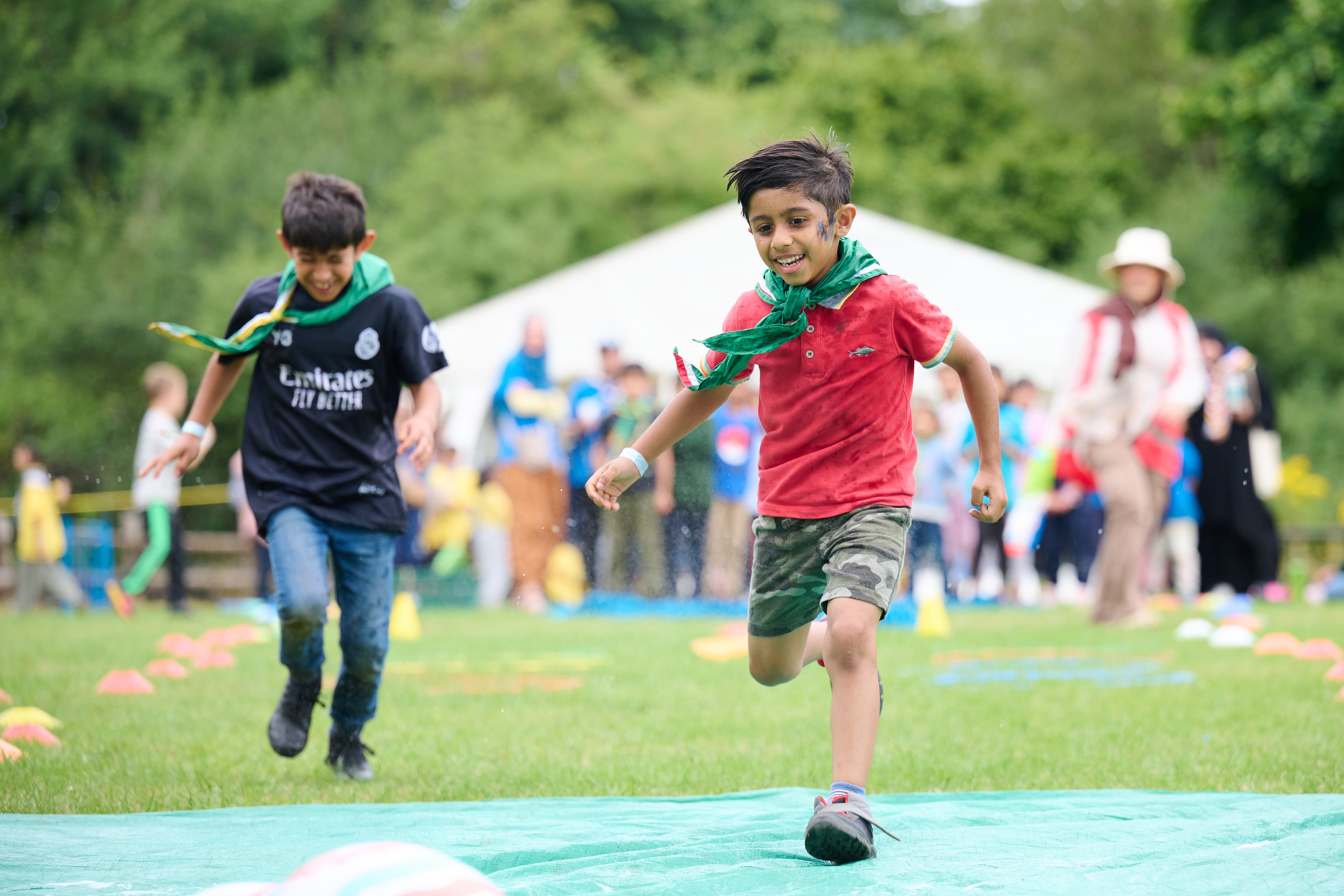
From delicious dishes to colourful clothes, catchy music to everyday words, South Asian culture has shaped life in the UK in all sorts of wonderful ways.
To celebrate South Asian Heritage Month, we’ve rounded up some brilliant games from the region for you to try out. Ready to play? Let’s go!
Games to celebrate South Asian Heritage Month
Kabaddi is a popular sport that first originated in Ancient India.
Divide into two teams of seven and create a halfway line using cones, masking tape or chalk. Each half should have a backline to mark the rear boundary. Close to each backline is a baulk line, which a raider must cross for their raid to be valid. Between these two lines is a bonus line. If a raider touches it and returns to their side, they’ll get extra points.
Each team begins on opposite halves of the playing area. They take turns choosing a raider, who wins points by tagging members of the other team before returning to their own half. They must complete the raid in one breath.
To prove that the raid takes place in one breath, they chant the word ‘kabaddi’ continuously.
When the raider tags a defender (someone from the opposing team), the defenders can try to block the raider from getting back to their own side.
If the raider is blocked after tagging a player, they’re out. The defenders score a point and may revive one player from their team who’s out. Players are revived in the same order they were put out.
If the raider makes it back to their side, then each defender touched by the raider, or whoever touched the raider, is out. The raiders score one touch point for each and can revive the same number of players.
If the raider doesn’t tag anyone, or they take a breath before returning, they’re out.
A team scores a bonus of two points, called a ‘lona’, if the entire opposing team is declared out. At the end of the game, the team with the most points wins.
Kho-kho is a traditional Indian game encouraging teamwork.
You’ll need a timer and two poles or cones. Mark out a rectangular playing area with chalk or masking tape. Draw a centre line down the middle and place two poles or cones at each end of the playing area.
Divide into two equal teams of six to twelve players. One team are the chasers and the other are the defenders.
The chasers line up on the middle line, facing in alternate directions. There should be a gap between each player. You can only ‘chase’ on the side of the pitch you’re facing.
The defending team line up on one end of the playing area. Defenders can run anywhere in the playing area, including on both sides.
On ‘Go’, the defenders enter the field in groups of three. Decide who’s running together before starting the game.
The chaser at one end of the line starts and tries to tag one of the defenders on the side of the field they’re facing. If a defender gets tagged, they’re out.
If a defender crosses the line to the other side, the chaser runs back to the line and taps a teammate, who’s facing in the other direction, and shouts ‘Kho!’. This person then becomes the chaser and the previous chaser rejoins the line, standing in the direction they were previously facing.
The new chaser must then try to tag any defender on their side. Chasers can swap with a teammate every time a defender moves into the opposite side of the pitch.
The chaser’s aim is to tag all the defenders quickly. The game ends when all the defenders have been tagged and the teams swap roles.
The team that gets the defenders out the quickest, wins.
Gandu Filla is a traditional game in the Maldives.
For this game, you’ll need a duvet cover or blanket.
Choose someone to be the guesser. They stand away from the group, so they can’t hear or see who’s chosen to hide.
Pick a person to be the hider. They should hide inside a sheet, such as a duvet, known as gandu.
Everyone else should hide elsewhere in the space.
When the guesser returns, they must say or sing, ‘Gandu heley heley.’
At this point, the player inside the sheet must shake and move, but stay silent, so they don’t give away their identity.
If the guesser figures out who it is, they win.
The person inside the sheet becomes the next guesser and the game is played again, with someone new in the sheet.
Crab racing is a popular game in the Maldives. You can have your own race, using people instead of crabs.
Mark out a start and finish line over a short distance using cones, flags or chalk.
Everyone should get into the crab position, also known as a bridge.
Lie on your back and bend your knees. Bend your elbows and bring your hands up beside your ears. Place your palms flat on the ground with your fingers facing your toes. Push yourself up so your hips, back and shoulders are off the ground.
Let everyone get into position on the start line. When you’re ready, shout ‘Go!’ and players can start slowly moving towards the finish line.
Take care, make sure to be aware of your surroundings and each other, and stop if you need to.
The first person to cross the line is the fastest crab!
If people struggle to do the bridge position, you could make a crab position by having everyone stand facing sideways. Stand slightly squatted with your feet wide apart, making crab claws with your hands, and move sideways across the space.
Marbles is also known as Kelereng in Indonesian and Malay. Some Indian games involving marbles are also known as Kancha or Kanche, or Golli Gundu.
You’ll need a set of marbles for every two players and some string or chalk to mark out a circle.
Get into pairs and scatter the marbles within the boundaries of the circle. The more marbles you start with, the longer the game will be.
You’ll need one shooter marble for every player – they’re larger than the other marbles in the set.
The goal is to score points by knocking marbles outside the circle using your shooter marble.
Choose a player to go first.
The first shot is taken from outside the ring. The shooter cradles the marble in the crook of their index finger and flicks it toward the marbles inside the ring.
When a player successfully knocks another marble out of the ring, they score a point and continue taking turns until they miss.
If a shooter remains inside the ring, they must take their next shot from its position.
If a shooter goes outside the ring, the player can position their marble anywhere outside the circle on their next turn.
The game is over when all marbles have been knocked out of the ring. Whoever scored the most points is the winner.
Popular in Pakistan, Baraf Paani/Baraf Pani means ‘ice and water’. It’s a version of freeze tag.
One player is selected to be ‘it’ – give them a sports bib, sash or necker to wear. Everyone else should spread out around the space.
‘It’ should move to the centre of the playing area and count to three. Then the game begins.
‘It’ must chase after all the other players.
If ‘it’ tags a player and says 'Baraf,’ the tagged player must freeze in place. They can’t move until another player touches them and says 'Paani.’ The first player is then ‘defrosted’ and free to move again.
If all players are frozen, the game ends. Or, if ‘it’ freezes someone three times, it’s their turn to be ‘it’.
Chor Police is similar to Cops and Robbers. Its origin isn’t known, but it’s played across Southeast Asia.
You’ll need a large space and some cones to mark out a ‘jail’ square.
Choose a quarter of the group to be the Police (Cops) who’ll need to work together to try to catch the Chors (Robbers).
Use a sports bib, sash or necker to identify the Police.
Everyone else will be the other team, the Chors.
Show everyone where the jail is and make sure it’s easily accessible.
When the game starts, the Police must catch the Chors. If you catch a Chor, lead them to jail.
The Chor must stay there until another untagged member of their team comes to the jail, tags them and says, ‘You’re free.’
If nobody comes and frees the Chor, they can’t escape. A jailed Chor can’t free another jailed Chor.
You can ask an adult volunteer or Young Leader to be the ‘jailer’ to make sure all the escapees are freed fairly.
When all the Chors are caught by the Police, the game ends.
Seven Stones is one of the most ancient, traditional games of the Indian subcontinent. It’s been played for the last 5,000 years.
You’ll need a large space, a soft foam ball and a timer.
Use foam dice or soft building blocks to make a tower, and a hula hoop, cones or chalk to mark a space where the tower will be built.
Mark out a line at a suitable distance from the tower where the hitters can throw from.
Divide the group into two equal teams. Each team will take turns at being the ‘seekers’ or the ‘hitters’.
The seekers should build a tower using seven or ten blocks and get ready to try and catch the hitters’ balls to get them out.
A member of the hitters is chosen to go first. They throw a ball at the tower to knock it over.
If you can’t do it in three tries, you’re out. The ball goes to another hitter and they should try, and so on, until the tower is knocked down.
If your ball doesn’t knock down the pile and is caught by an opponent four times after the first bounce, then you’re out.
If your ball hits the piles, but an opposite team member catches it, then the whole team is out.
If the tower is hit, the seekers must try to rebuild it.
The hitter must try to hit the seekers with the ball before they can reconstruct the stone pile.
Hitters can’t run with the ball to hit the seekers.
If the ball touches a seeker, they’re out.
After rebuilding the tower, the seekers say ‘Seven Stones’.
The hitters then try to knock the tower down again, until all the seekers are out. The teams then swap over. Whoever gets all the seekers out in the fastest time, wins.
River or Mountain is known as Nadee-Parvat in Hindi, and Nadi ki Pahad in Marathi and other regional languages.
Find a large space and divide it into two sides using cones or chalk. Let everyone know which side is ‘rivers’ and which side is ‘mountains’.
Choose someone to be ‘it’. They stand in the middle of the space. Everyone else should line up on one side.
At the start of play, ‘it’ shouts out either ‘river’ or ‘mountain’.
All players should move to that area. While outside those areas, the players can be tagged by ‘it’.
Anyone tagged is out and the last player to be tagged is the winner.
Chain tag is a popular game in India.
Choose someone to be ‘it’ and spread out across a large space.
On ‘Go!’, ‘it’ must try to tag another player.
Tagged players must join hands with ‘it’ and become ‘it’ as well.
As people get tagged, they join the human chain by holding hands with the taggers, so the chain gets longer and longer.
Don’t let go of hands and break the chain. If you do, you need to rejoin together. You can’t tag people while the chain is broken.
Only the two players at either end of the chain can tag the remaining players, since they have a free hand.
The game ends once all players have been tagged. The last person to be tagged is the winner.
Kokla Chapaki is a traditional game played in the streets of Punjab, India.
It also goes by different names in India, such as ‘Ghoda Chamar Khai’. You might know it as ‘Duck, Duck, Goose’.
You’ll need a large space and a handkerchief or necker.
Choose one person to be the ‘seeker’. Ask everyone else to sit in a circle. While running around the circle, the ‘seeker’ quietly drops the handkerchief behind a sitting player.
When they realise the handkerchief is behind them, the player must pick it up and try to catch the seeker before they sit in their space.
If tagged, the seeker remains and the game continues.
If the seeker makes it back to the space, the person who was tagged becomes the seeker and the game continues.
Staying safe and making it accessible
All activities must be safely managed. You need to complete a risk assessment and take appropriate steps to reduce risk. Use the safety checklist to help you plan and risk assess your activity. There’s lots of guidance to help you carry out your risk assessment, including examples.
Always get approval for the activity and have suitable supervision and an InTouch process.
Make sure all young people and adults involved in the activity know how to take part safely. Find out more about running active games safely in Scouts and making active games accessible.