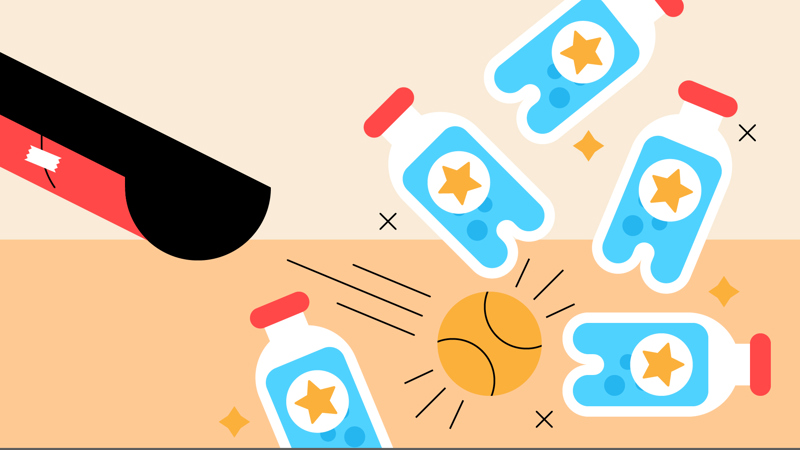
Try DIY bowling
You’ll need
- Clean, empty plastic bottles (500ml)
- Clean, empty plastic bottles (two litres)
- Sticky tape
- A4 paper
- Tennis balls
Before you begin
- Use the safety checklist to help you plan and risk assess your activity. There’s also more guidance to help you carry out your risk assessment, including examples.
- Make sure all young people and adults involved in the activity know how to take part safely.
- Make sure you’ll have enough adult helpers. You may need some parents and carers to help.
Planning and setting up this activity
- Ask everyone at home to save empty plastic bottles—small ones (500ml) work best. You’ll need five bottles for each game. If you don’t have plastic bottles, you can use tin cans instead.
- Want to make a ramp? Try using a piece of plastic guttering. You can line it with paper to help the ball roll more smoothly.
- You may wish to mark out an alley, including a throwing line and a ‘X’ marked for each skittle to stand on. You could use rope, chalk, masking tape or jumpers to mark the lines.
- Each set needs one ramp and five skittles. It’s up to you how many sets you make.
Running this activity
- Each group or person should gather their five bottles together.
- Fill the bottles with a bit of water, sand or small pebbles to help weight them down.
- If you want to, decorate the bottles. You could wrap them in paper, use colourful tape or use permanent markers.
- Now set out five skittles at the end of each bowling alley.
- You can run this as a team game or individually:
- Each team should choose a team name.
- Different people should take on different roles. For example, holding the ramp, directing the ramp, releasing the ball, and collecting the ball.
- The first team should stand by the bowling line.
- They should work together to set up the ramp, then release a ball down the ramp to try to knock down the skittles.
- The team gets one point for each skittle they knock over. Make sure that each team stays behind the bowling line. If the team has knocked down all five skittles, they should be reset so they can keep scoring until their time’s up.
- Give each team the same amount of time to score as many points as they can.
- At the end, add up the points to find the winner.
- You may wish to have a set number of turns, rather than a time limit.
- Each group should set up their own alley, with skittles at one end and a throwing line.
- Next, note down everyone’s names.
- Decide if you’re going to use the ramp or throw the ball. You may wish for everyone in the group to do the same thing or let people choose their preferred way.
- Each person should then carefully aim, roll the ball and try to knock over the skittles. You get 1 point for each skittle you knock down!
- If you knock down all 5 skittles, set them back up and keep going until your time is up.
- Everyone gets the same amount of time to play.
- At the end, add up the scores and see who wins.
- You may wish to have a set number of turns, rather than a time limit.
Tidy up
- People can take their game home to reuse it or you may wish to keep one to use for the group.
- If not, everyone should empty the skittles, and remove any sticky tape, paper, and decoration from the bottles.
- At the end recycle the (cleaned) plastic bottles and any paper.
Reflection
This activity was a chance to be a team player. Talk to your team, and think of one thing you found easy about working together, and one thing you found difficult. Once everyone’s ready, share your ideas with the other teams. Did people have similar answers? Sometimes teams have problems and they have to work together to solve them. What did you do to solve any problems? Would you do anything differently next time you work in a team? It can be tricky to work in a team, so well done for giving it a go!
This activity was also a chance for some people to be great leaders. Was anyone in your team a good leader? It can be tricky and confusing if everyone tries to lead the team at once—was it challenging to listen to someone giving directions? Why do you think teams have leaders?
Safety
All activities must be safely managed. You must complete a thorough risk assessment and take appropriate steps to reduce risk. Use the safety checklist to help you plan and risk assess your activity. Always get approval for the activity, and have suitable supervision and an InTouch process.
You must run your activities in line with the Safeguarding Code of Conduct for Adults (Yellow Card) and report any concerns to the UK HQ Safeguarding Team.
- Scissors
Supervise young people appropriately when they’re using scissors. Store all sharp objects securely, out of the reach of young people.
- Active games
The game area should be free of hazards. Explain the rules of the game clearly and have a clear way to communicate that the game must stop when needed. Take a look at our guidance on running active games safely.
- People could decorate the pins. They could also help stick the ramp together (but an adult should be the one to cut the bottles, before anyone else arrives).
- Experiment with different skittle set-ups—as people get used to it, you could use the traditional ‘V’ shape, or you could come up with your own.
- Move the bowling line closer or further way to change the challenge.
- You could also time how long it takes teams to knock over five skittles, rather than giving them a set time to knock over as many as possible.
Teams can stand or sit to set up their ramps and roll the balls.
All Scout activities should be inclusive and accessible.


Now you’ve made the ramps, see if you can use them for another fun challenge before you recycle the bottles. For example, you could use them to move water from one bucket to another—the winning team is the one with the most water in the second bucket. You could even poke holes in the ramps to make the game trickier (and wetter). This could count as an outside activity for the My Adventure Challenge Award or the Our Adventure Challenge Award.
Different people can take it in turns to lead the game, making sure everyone’s behind the line, keeping score, and offering hints to the team that’s playing.