Pride quilts
You’ll need
- Craft materials (for example, tissue paper, pipe cleaners, stickers)
- Scrap paper
- A4 card
- Coloured pens or pencils
- Paint
- Paint brushes
Before you begin
- Use the safety checklist to help you plan and risk assess your activity. Additional help to carry out your risk assessment, including examples can be found here. Don’t forget to make sure all young people and adults involved in the activity know how to take part safely.
- Make sure you’ll have enough adult helpers. You may need some parents and carers to help if you’re short on helpers.
- Some people may be in the process of questioning their sexual orientation or gender identity or may not have shared their identity with anyone. Make sure everyone knows they don’t have to share anything about themselves if they don’t want to. It’s important that everyone feels comfortable in this activity, as well as knowing how they can access support.
- Young people may share aspects of their identity that may be new to them, new to you or new to the rest of your group. This is a very brave thing to do, and it's extremely personal and different for everyone. Make sure you look out for these individuals and provide a safe and calm space for them to process their emotions. Make sure to model affirming responses to anything shared by your young people.
- There's a range of labels young people and adult volunteers may use to describe their sexual orientation or gender identity. For example, asexual, pansexual, nonbinary, or questioning. Take the time to research these, so you feel comfortable in your knowledge of them should a young person or adult want to discuss their sexual orientation or gender identity with you.
- It's the responsibility of all adults in Scouts to help develop a caring and supportive atmosphere where bullying in any form is unacceptable. Look out for any signs of homophobic and/or transphobic bullying and language. See our guidance on preventing and dealing with bullying. You may want to create a zero-tolerance policy towards LGBTQ+ bulling or discrimination within your Section or Group rules.
- You may want to visit our LGBTQ+ pages to find out more about supporting LGBTQ+ members in Scouts.
- Explain that in the 1980s-1990s there was an epidemic (similar to a pandemic) across the world, similar to COVID-19. However, a lot of people thought this illness could only be caught from LGBTQ+ people as many of the first people who got ill were LGBTQ+. This was called the HIV/AIDS epidemic.
- From 1981 to 1983, over 550 people in America had died from AIDS related illnesses. There wasn’t a lot of support for people who had AIDS during this time because of homophobia. People often thought if you had AIDS then you were LGBTQ+ and many people’s families refused to talk to them once they received their diagnosis.
- Some famous people you may have heard of who died during this time are Freddie Mercury and Keith Haring.
- In 1987, a man called Cleve Johns created the first panel of the AIDS Memorial Quilt in memory of his friend Marvin Feldman. The goal of the quilt was to create a memorial for those who had died from AIDS related illnesses and to document their lives so that they weren’t forgotten by history.
- By 1989, over 20 countries had launched similar projects to remember those who died from AIDS related illnesses.
- The Memorial Quilt is incredibly large. It was last displayed all together in 1996 with over 40,000 panels and filling the National Mall in Washington DC (that’s over 1.9 miles long!).
- Each panel on the quilt was dedicated to one or more people who died from AIDS related illnesses. It celebrated who they were, what they loved and some included messages to their loved ones and friends who died.
- You may want to spend some more time looking at the Memorial Quilt. The USA AIDS Memorial Quilt has over 50,000 panels and the National AIDS Memorial organisation has an online interactive virtual exhibition of the quilt available on their website (https://www.aidsmemorial.org/).
- The UK also has a Memorial Quilt that you can view online at https://www.aidsquiltuk.org/.
Learn about Pride
- Ask if anyone knows what Pride month is.
- Explain that Pride month is a time to celebrate LGBTQ+ people and show our support for their community, though we should be doing this all year round.
- Tell everyone that at Scouts, we welcome and accept everyone, regardless of their sex, gender identity or sexual orientation.
- Speak about why it’s important to learn about LGBTQ+ history. This can show our support for the community and help our own understanding. We need to know how LGBTQ+ people have faced persecution, discrimination and hostility, so we understand what the community have faced and how we can prevent it happening in the future.
- Explain that a lot of people may have had negative reactions, experienced bullying or abuse, or been discriminated against because they’re part of the LGBTQ+ community. So actively learning about LGBTQ+ history and giving vocal and visible support can help people to feel loved and accepted for who they are.
- Visible support, such as displaying Pride flags, and celebrating the LGBTQ+ community can also show that Scouts is a safe space for LGBTQ+ people. It means we can celebrate the inclusion and diversity we’re so proud of. Individuals can also display or wear Pride flags to show that they’re allies, which means friends, to people in the LGBTQ+ community.
- We can also show support to the LGBTQ+ community by being non-judgemental, avoiding assumptions and being accepting of everyone, challenging language misuse and reporting any homophobic and transphobic bullying to an adult.
Make the quilt
- Have a chat with everyone about what the Pride quilt is.
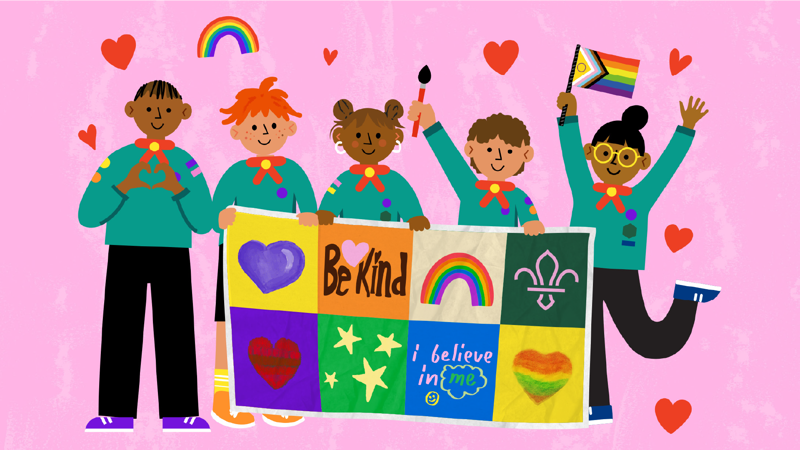
- Explain that today you are all going to work together to make a Pride Quilt that represents everyone in your section.
- Everyone can take a piece of paper each and fill the page with their own design to represent themselves.
- They may want to draw or write pictures, symbols, song lyrics, words and phrases that sum up who they are. This is an opportunity for everyone to celebrate who they are and what makes them, them!
- They may want to stick stickers, buttons and other craft items to their panel.
- Once everyone has finished, lay all of the panels out together on the floor and let everyone have the opportunity to have a look at the final product.
Reflection
In this activity, we learned about LGBTQ+ history. Did anyone already know anything? What did you learn? Did anything surprise you?
Why do you think LGBTQ+ History Month is needed? Why do you think it’s important to learn about LGBTQ+ history? What do you think it’s like today for LGBTQ+ people in America? Do you think that all LGBTQ+ people have similar experiences? What could we all do to make the world a better place for the LGBTQ+ community?
Looking at the quilt you have made as a group today, have you learned anything new about anybody else? How did it make you feel to celebrate who you are and the things that make you, you?
Safety
All activities must be safely managed. You must complete a thorough risk assessment and take appropriate steps to reduce risk. Use the safety checklist to help you plan and risk assess your activity. Always get approval for the activity, and have suitable supervision and an InTouch process.
You must run your activities in line with the Safeguarding Code of Conduct for Adults (Yellow Card) and report any concerns to the UK HQ Safeguarding Team.
- Glue and solvents
Always supervise young people appropriately when they’re using glue and solvent products. Make sure there’s plenty of ventilation. Be aware of any medical conditions that could be affected by glue or solvent use and make adjustments as needed.
- Scissors
Supervise young people appropriately when they’re using scissors. Store all sharp objects securely, out of the reach of young people.
- Some of these terms may be new to people. You may want to ask if everyone knows what LGBTQ+ stands for and if everyone knows what homophobia and transphobia are. Someone may volunteer to explain to everyone else what these words mean, or you may want to provide an explanation yourself.
- LGBTQ+ stands for lesbian, gay, bisexual, trans and queer. The plus refers to other sexuality and gender identity terms, such as pansexual and asexual. This acronym is used to describe a community of people who are minorities because of their gender identity or sexuality.
- Homophobia is a type of discrimination, bullying or prejudice that targets people who are (or perceived to be) sexual minorities (eg. they aren’t heterosexual or straight), while transphobia targets people who have (or are perceived to have) a gender identity that is different to their sex assigned at birth.
- Scouts is open to all and welcomes young people and adults, regardless of their sexual orientation. It's important that in Scouts all young people and adults feel welcome, included and valued for who they are. Be aware that someone who's LGBTQ+ may have experienced discrimination or bullying in other areas of their life. Therefore, it’s ever more important that Scouts creates a positive, supportive environment which actively celebrates difference.
- It's the responsibility of all adults in Scouts to help develop a caring and supportive atmosphere where bullying in any form is unacceptable. Be vigilant for signs of homophobic and/or transphobic bullying and language. See our guidance on preventing and dealing with bullying. You may want to create a zero tolerance policy towards LGBTQ+ bulling or discrimination within your Section or Group rules.
- Young people may share aspects of their identity that may be new to them, new to you or new to the rest of your group. This is a very brave thing to do, and it's extremely personal and different for everyone. Make sure you look out for these individuals and provide a safe and calm space for them to process their emotions. Make sure to model affirming responses to anything shared by your young people.
- Act as a role model or ally, regardless of your own sexual orientation, by being open and raising awareness about all sexual orientations. You don't need to be an expert. Adult volunteers who're open, offer positive messages and challenge homophobia and transphobia, will make a real difference in creating a more inclusive environment.
- Consider the language used within your section. Think about the impact on Scouts who may be gay or questioning their sexual orientation. The misuse of ‘gay’ as a negative is common, such as “that’s so gay”. This may lead young people to equate their feelings as something to be kept secret or wrong, which's damaging for their self-esteem, particularly if young people are just coming to terms with their sexuality.
- There's a range of labels young people and adult volunteers may use to describe their sexual orientation or gender identity. For example, asexual, pansexual, nonbinary, or questioning. Take the time to research these, so you feel comfortable in your knowledge of them should a young person or adult want to discuss their sexuality or gender identity with you.
- You may want to visit our LGBTQ+ pages to find out more about supporting LGBTQ+ members in Scouts.
- If anyone needs help or struggles with fine motor skills, give them the opportunity to work in pairs, with a young leader or an adult volunteer. Alternatively, swap out the items for something easier to handle.
- People who struggle with making choices could find all the options a bit overwhelming, so they might need extra support or to work with a young leader/volunteer to be able to create their artwork.
- If anyone needs support in using craft items, allow them to work with someone else who can help them.
All Scout activities should be inclusive and accessible.