Make your own Djembe drums
You’ll need
- Scissors
- Elastic bands
- String
- PVA glue
- Masking tape
- Coloured pens or pencils
- Paint
- Paint brushes
- Plant pots
- Paper cups
- Old plastic bag (with no holes)
- African symbols, African prints or fabric, African beads to decorate the drums (optional)
Before you begin
- Use the safety checklist to help you plan and risk assess your activity. There's also more guidance to help you carry out your risk assessment, including examples.
- Make sure all young people and adults involved in the activity know how to take part safely.
- Make sure you’ll have enough adult helpers. You may need some parents and carers to help.
Planning and setting up this activity
- It’s up to you whether you use paper cups or plant pots to make your drum. Both work well.
- It may be useful to make an example.
Running this activity
- See if anyone can name any countries in Africa. For example, Kenya, Ghana, Madagascar, Nigeria, and so on. You may want to use a map or globe.
- Explain that djembes are drums from West Africa.
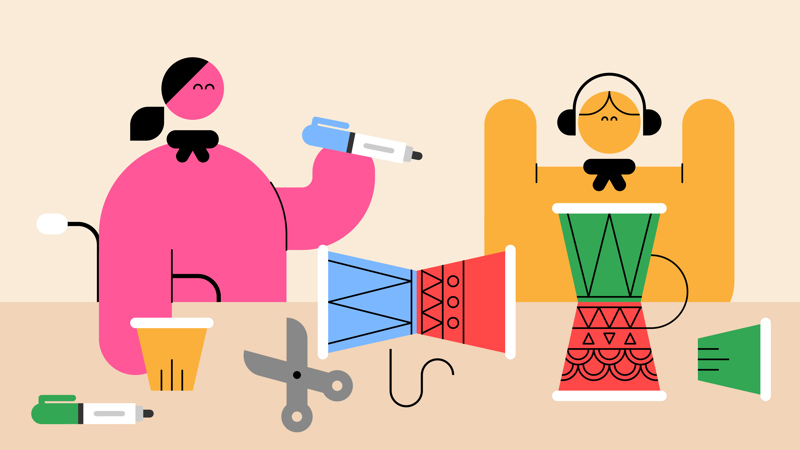
- To make a Djembe drum, use masking tape to stick the bottoms of two cups together.
- Decorate the cups using colouring pens and pencils.
- Tie an elastic band loosely where the cups join, over the masking tape.
- Lay a plastic bag flat. Place a cup upside down on it and draw a circle around the rim.
- Remove the cup and draw a larger circle around the first one.
- Carefully cut out the larger circle with scissors (an adult can help).
- Place the plastic circle on top of the drum, pull it tight, and secure it with another rubber band.
- Cut a long piece of wool and tie one end to the middle rubber band.
- Loop it under the top rubber band, pull it straight, and tie a knot.
- Zig-zag the wool around the drum, going over and under the rubber bands, tying knots as needed.
- If you run out of wool or want a new colour, tie on a new piece and continue.
- To make a handle, loop wool from the top rubber band to the middle one.
- When everyone’s finished, someone can clap or play a rhythm for others to copy. You could even put on a performance for parents or carers.
African drums are usually made from wood, metal or clay and come in different sizes. If the drum has a large body, it will produce a lower pitch and if the drum head has a tight tension, a high pitch will be produced.
The player will strike the drum with their hands, sticks or both. Drums are highly decorated with carvings or beadwork because they are treasured assets within African communities. Added beads or rattles can change the timbre of the drum. The timbre is the tonal quality or sound of an instrument that distinguishes it from others.
Some different African drums include:
Djembe: One of the best-known African drums is the West African djembe. It is shaped like a large goblet and played with bare hands. The body is carved from a hollowed trunk and is covered in goat skin.
Talking drum: The talking drum is a West African instrument that has drum skins on both the top and bottom of its body. It is played with a beater and the performer is able to squeeze the drum’s tension chords, which changes the pitch of the drum, imitating a human voice.
Dundun: Often played in groups, a dundun is made of cow skin and is played on the floor and with a beater-stick. It is often played as the bass drum in the ensemble. Dunduns are double-headed and belong to the family of hourglass-shaped pressure drums. The pitch of the note is changed by squeezing or releasing the drum's strings with the arm. Dundun drums are played whilst placed on the floor.
(Source: BBC Bitesize, 2025)
The influence of African music on popular music is still heard today. It was transported to America along with the thousands of enslaved people from Africa during the slave trade.
It was combined with the folk music of the European settlers to produce new styles of music such as blues, jazz and rock ’n’ roll:
- Rock ‘n’ Roll music style in the 1950s that includes guitars, drums, vocals and double bass. Often orientates around the 12-bar blues.
- Jazz is a genre of music that has swing and syncopated rhythms, and extended chords.
- Blues is an African-American form of music. Blues songs are often about hardship, but are meant to be life-affirming and ultimately uplifting for the listener.
Famous artists include Jalihunda African Drums, Ladysmith Black Mambazo and Soweto Gospel Choir.
Many genres of music from pop songs to modern classical music are linked to music from Africa. Films such as The Lion King and Blood Diamond are set in Africa, using elements of African music to help set the scene.
(Source: BBC Bitesize, 2025)
Funga alafia
This is a ‘welcome dance’ song, sung in the Yoruba language used in countries including Nigeria and Liberia. You can drum or dance along to this song to welcome everyone.
Leader: Funga alafia (fun-ga a-la-fi-ya)
Group: Asé, asé (ah-shay)
O zim zim
A simple drumming call-and-response song from West Africa.
Leader: O zim zim
Group: O zim
Leader: O racataya
Group: O ya
Do do ki do
A Cameroonian children’s song, sung with drumming for a Cameroonian mask dance.
All:
Do do ki do, ti na baba
Do do ki do, ti na baba
Do do do, ti la so la so
Kye Kye Kule
This is a call-and-response song from Ghana. It is similar to 'Heads, Shoulders, Knees and Toes' so you should do the actions when singing this song.
Leader: Kye Kye Kule (chay chay koo-lay)
Group: Kye Kye Kule
(Hands on your head)
Leader: Kye Kye Kofinsa (chay chay koh-feen sah)
Group: Kye Kye Kofisa
(Hands on your shoulders)
Leader: Kofisa Langa (koh-fee sah lahn-gah)
Group: Kofisa Langa
(Hands on your waist)
Leader: Kaka Shilanga (kah-kah shee lahn-gah)
Group: Kaka Shilanga
(Hands on your knees)
Leader: Kum Aden Nde (koom ah-dehn day)
Group: Kum Aden Nde
(Hands on your ankles)
Leader: Kum Aden Nde (koom ah-dehn day)
Group: Kum Aden Nde, HEY!
(Hands on your ankles)
Black History Month takes place every October in the UK. It started in the United States in 1926. In the UK, Black History Month began in 1987 and is an important opportunity to celebrate and learn about Black history. During this month, schools and communities hold events, activities, and discussions to highlight important figures, such as activists, artists, and leaders. This month is a chance for everyone to appreciate the rich culture and history of Black communities and to understand the impact they have had on our society. However, it’s important to remember that Black history is a part of history that people can (and should) learn about all year round.
This activity has been chosen as it celebrates Black music.
Reflection
Going around the circle, play a short rhythm then say how you found the session – for example, *beat* *tap* ‘fun’. The rest of the group can then repeat this. It’s OK to use the same words as each other to describe the session.
Music can bring us together and help us learn about different cultures. What did you enjoy about the songs? Why is it good to learn about different cultures? (To celebrate our differences, understand others and find similarities.)
Congratulations for playing and having the confidence to perform in front of an audience. How do you think it went? Even if you weren’t happy with your performance, remember you only had a short time to learn something new. This performance doesn’t need to be perfect, but if you keep practising, over time you will get better.
Safety
All activities must be safely managed. You must complete a thorough risk assessment and take appropriate steps to reduce risk. Use the safety checklist to help you plan and risk assess your activity. Always get approval for the activity, and have suitable supervision and an InTouch process.
You must run your activities in line with the Safeguarding Code of Conduct for Adults (Yellow Card) and report any concerns to the UK HQ Safeguarding Team.
- Scissors
Supervise young people appropriately when they’re using scissors. Store all sharp objects securely, out of the reach of young people.
- Rubbish and recycling
All items should be clean and suitable for this activity.
To make this easier, you can use call-and-response songs, or play and repeat rhythms.
Spread this activity over two meetings to allow everyone more time to practise the songs before performing them.
All Scout activities should be inclusive and accessible.
Invite some musicians who know the music to run a workshop for your section.
Watch a performance that uses African drums. You can find videos of performances online.
Learn about and try making some instruments from other parts of the world.
A young person could lead the group during the songs or when coming up with rhythms.