The volunteer joining journey
Understand the joining journey and your role in welcoming new volunteers.
Quick links
New volunteers are welcomed to Scouts through the joining journey. Digital tools help with checks and learning. By following Our Volunteer Culture, you’ll help new volunteers feel valued, supported and confident from the start.
As a Team Leader or Lead Volunteer, you’ll check in with new volunteers in their first weeks. You’ll explain how Scouts works, checks required, learning they’ll need to do and share the Safe scouting cards. You’ll introduce them to others, agree tasks, discuss making the Promise and getting a uniform (if relevant), share the welcome pack and explain where to get support.
Induction and Buddies. As part of the induction, Team Leaders and Team Members help volunteers understand their tasks, find what they need and feel part of the team. Linking them with a buddy gives support in their first few months.
Young Leaders. Young Leaders, (including those that complete the Young Leaders Scheme), Explorer Scouts, Network members need to complete each step of the joining journey, relevant for their new adult volunteer role, even if they already know the other adult volunteers.
Trustees. A volunteer who’s going to be a Trustee, is appointed at the Annual General Meeting, after an open selection process or co-opted by Trustees at a Trustee Board meeting during the year. This is not needed for roles such as Lead Volunteers or Youth Leads, where being a Trustee is automatically part of their role but must meet trustee eligibility before acting.
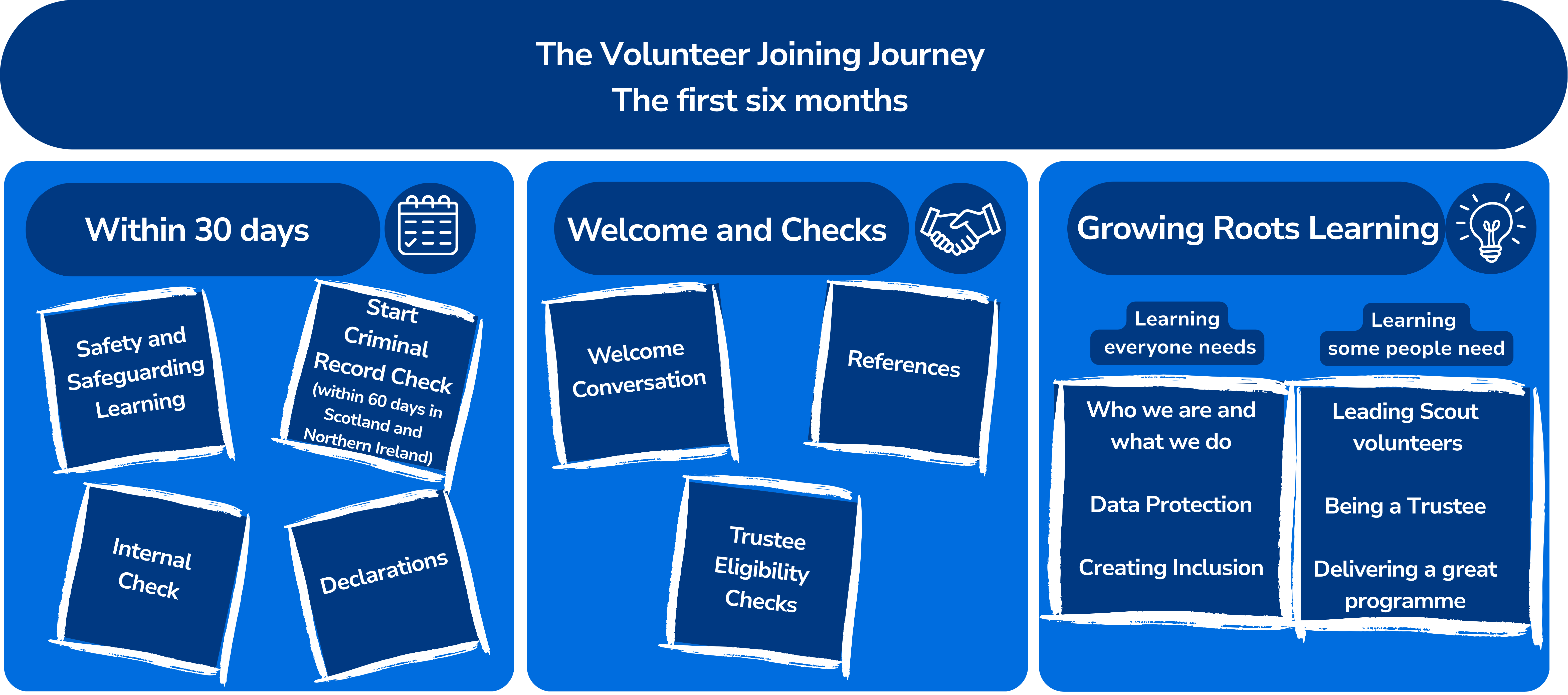
Timing. Volunteers complete the joining journey within their first six months. More than one step can be completed at a time. Some steps need to be completed within the first 30 days of a volunteer’s start date on My Membership.
Add new volunteer to My Membership
Purpose: My Membership is where volunteer’s information is stored and managed. Volunteers use it to complete actions, and track progress of the joining journey. Once a full member, they’ll use it to complete tasks. For example, manage their teams, submit a night’s away notification and apply for permits.
Keeping on top of actions through the joining journey shows where support might be needed and helps create an easy and welcoming experience.
Who’s involved:
- The new volunteer and depending on the new volunteer’s role, their Team Leader or Lead Volunteer or Chair of the Trustee Board.
- Leadership Team Members and volunteers with the Recruiter accreditation can add new volunteers to My Membership.
When: As soon as someone agrees to volunteer.
What happens:
- Basic details of the new volunteer are added to My Membership. They'll sign in to update their information. Actions can be viewed in the Action List.
- Use the joining journey dashboard in Data Explorer to track the progress of volunteers within your teams, through their joining journey.
- View the role approval audit to find out the progress and status of each step of an individual’s joining journey.
Support:
- Share the quick start guide with new volunteers to help them sign in to My Membership for the first time.
- Read the add new member guide learn how to do this in My Membership.
- Read the Dashboards and Reports guide to find out how to view the joining journey dashboard.
- Read the role approval audit for a member’s role guide to learn how to see the status of each step in a volunteer’s joining journey.
Declarations
Purpose: Completing the declaration is a way for volunteers to confirm they’ll follow our rules, act within our Scout values and that they’ve read and agree to follow our policies, for example safety and safeguarding. For Trustees, it also confirms they’re legally allowed to be a charity trustee.
Who’s involved: The new volunteer
When: Within the first 30 days.
What happens: New volunteers open the action in My Membership, read the declaration, tick to confirm they agree. They’ll click submit to complete the action.
Support: Read the scouts.org.uk Quick Start guide to learn how a volunteer can sign the declaration in My Membership.
Criminal Record Check
Purpose: Checks help safeguard young people and keep Scouts a safe place. They’re a way to make sure only appropriate adults volunteer with the Scouts.
Who’s involved:
- The Team Leader or volunteer with a Disclosure Support Volunteer accreditation, and the new volunteer who requires a criminal record check.
When:
- Started within the first 30 days (England, Wales and British Scouts Overseas and Overseas Territories)
- Started within the first 60 days (Scotland and Northern Ireland).
What happens:
- Request a criminal record check in My Membership.
- Volunteers in England and Wales complete the check through a digital tool called Atlantic Data.
- Checks for volunteers in Scotland, Northern Ireland, British Scouts Overseas and Overseas Territories are completed through different processes and tools. They’re managed within My Membership.
- Volunteers will need to complete a criminal record check, even if they have one for another organisation.
Support:
- Read the completing criminal record checks pages to learn about which roles need a check and how this is completed in your location.
- Read the criminal record checks/disclosures guide to find out how to request and view the status of criminal record checks/disclosures in My Membership.
- Volunteers with the Disclosure Support Volunteer accreditation can help volunteers (if necessary) complete their criminal record check.
Internal Check
Purpose: Internal Checks make sure there is nothing in our records that would mean someone couldn’t become a member.
Who’s involved: Scouts UK Headquarters (UKHQ)
When: completed once the criminal record check outcome and all relevant information has been risk assessed at HQ.
What happens: Scouts UK Headquarters (UKHQ) check internal records.
Purpose: References provide information about new volunteer’s character. This helps to assess whether they’re suitable to volunteer with the Scouts.
Who’s involved:
- The new volunteer.
- Lead Volunteers and Volunteer Safeguarding Lead complete a manual reference check, if required.
When: References must be completed within the first six months.
What happens:
- New volunteers enter their referee details into My Membership.
- Referees should be aged 18 or over, know about the volunteer’s work or contact with young people and be able to comment on their character and relationships with others. They must not be a relative of the volunteer. At least one referee should have known them for at least 5 years. One referee will be from outside of Scouts.
- Referees will be contacted to provide information. My Membership marks references as satisfactory if they meet the referee requirements and there are no comments or issues raised.
- Any references with comments need a manual check. The outcome of the check might be, the reference is accepted, a request for new referee details or the information provided means the person would not be suitable to volunteer.
Support: Read the references digital tool guide to find out how to request, view and manage references.
Welcome Conversation
Purpose: Helps new volunteers feel valued, informed and supported. They can share why they want to volunteer, discuss their availability and role fit. This helps create a welcoming environment, which encourages people to volunteer.
Who’s involved:
- The new volunteer, a volunteer with the Welcome Conversation Volunteer accreditation (who’s independent, for example not in the same Group or Explorer Unit, where the new volunteer is joining) and the Team Leader.
- For roles in Section Teams, the Group Lead Volunteer attends instead of the Team Leader. For Explorer section roles, the District 14-24 Team Leader attends.
- Volunteers running the Welcome Conversation will need to complete the Welcome Conversation Learning.
- Trustees don’t need a Welcome Conversation if it’s their only role.
When: Within the first 30 days. If this is not possible, then within the first six months.
What happens: A conversation takes place to
- welcome the volunteer and help them feel part of the team,
- understand the support they need in their role and check that volunteering with Scouts is right for them
- answer any questions they have,
- explain learning and development and
- make sure they understand and commit to Scout values, expectations, the Scout Promise (if relevant), volunteering culture, and safeguarding practices, including the Yellow and Purple Cards.
Support:
- Read Understanding Welcome Conversations to find out more about before, during and after the conversation.
- Read the welcome conversation digital tool guide to find out how to record a welcome conversation and how to find welcome conversation volunteers in My Membership.
Growing Roots Learning
Purpose: Learning builds knowledge and confidence so volunteers can do their role, follow our polices and rules and keep young people safe.
Who’s involved: The new volunteer
When:
- Safety and Safeguarding learning within the first 30 days.
- The rest of Growing Roots learning within the first six months.
What happens:
- Volunteers sign in to My Learning through scouts.org.uk to complete their Growing Roots learning.
- Everyone will need to complete:
- Safety
- Safeguarding
- Who we are and what we do
- Creating inclusion
- Data protection learning.
- Depending on their role, volunteers will also need to complete learning about, Leading Scout Volunteers, Delivering a Great Programme, Being a Trustee.
Support:
- Read the Learning you need to do: Growing Roots page to find out more about learning and how to complete it.
- Read the Manage and assess learning guide to find out how to check your team’s learning and create a learning report.
Purpose: Checks to make sure a volunteer can legally be a Trustee.
Who’s involved: The new volunteer, Chair of the Trustee Board, Lead Volunteer or Team Member who does the administration for the Trustee Board.
When: Within the first 30 days. If this is not possible, then within the first six months.
What happens: Trustee Eligibility Checks are completed to confirm the volunteer can be a Trustee. Lead Volunteer or Chair records the checks have been completed in My Membership.
Support: Read Trustee Eligibility Checks guide to find out how to record the checks in My Membership.
Purpose: First Response learning helps volunteers understand how to deliver basic first aid and manage medical emergencies, relevant to Scouts. This helps keep young people safe and volunteers prepared.
Who’s involved: Section Team Members, Section Team Leaders, Group Lead Volunteers, 14-24 Team Leaders, volunteers who may work directly with young people on a regular basis, First Response Trainers.
When: Within the first 12 months. Learning will need to be renewed every three years.
What happens: Volunteers who are required to complete First response will need to register locally for this learning.
Support: Find out more about First Response.
The full list of the joining requirements for each role can be found in the POR Teams Table in Chapter 16.