Safety Checklist Cards
Safety checklist for Trustee Boards and their members
Quick links
(Published May 2026, replacing August 2021)
Everyone’s responsibility
Safety is a shared responsibility in Scouts. We acknowledge that life, and by extension, our programmes, are not without risk. As Scouts, we strive to manage these risks to wellbeing and safety, aiming to reduce them to the lowest level reasonably practicable. Identifying and proportionately managing risk is a lifelong skill that we aim to foster, develop and enhance in all our members.
This Safety checklist card is designed to help all members of Trustee Boards understand their role in building a strong safety culture across Scouts. This reflects the latest policy and guidance to help you understand your responsibilities and work with your Trustee team to support Scout experiences while keeping everyone safe.
As a Trustee Board member, you have a pivotal role in overseeing, supporting, monitoring and reviewing safe practices. You set expectations and make sure safety measures are effective. Your support is crucial in making Safe Scouting the norm.
Remember: Your role is to guide and oversee, not to do every task yourself. You make sure the systems are in place and working while volunteers carry out day-to-day activities.
Leading by example
Working together
Guide and support safety locally
Plan - Set the direction
- Be informed: Read and understand the Safety Policy (POR Chapter 2).
- Stay prepared: Safety should be a standing agenda item at all meetings.
- Seek help: Remember to use external technical expertise if needed, especially in areas where specialist knowledge may be required, for example, in respect of electrical installations.
- Wider support: Counties should appoint a County Safety Advisor who can support and guide the Trustee Board. Districts may have a District Safety Lead to support Scouts locally.
Do - Enable Safe Scouting
- Empower volunteers: Ask for reassurance that all Team Members have completed mandatory safety learning. Visit Section meetings to understand their needs.
- Support safety: Make sure risk assessments are carried out and that necessary controls (such as fire alarms or first aid kits) are in place.
- Act promptly: Support or take action on identified issues in a timely manner (such as a faulty stove).
- Encourage reporting: Create an environment where people feel comfortable reporting hazards or incidents so the Trustee Board can act upon and resolve them.
Check - Assure and review
- Monitor and review: Support Lead Volunteers in reviewing and monitoring learning and training compliance.
- Tools and resources: Use checklists and tools to support and guide others.
- Keep a Risk Register: Maintain a log of significant risks (not just activities, but also meeting place-based, financial and legal risks) and review it regularly.
- Learn from incidents: Review incident reports to see if procedures, equipment and facilities need to be updated to prevent reoccurrence.
Act – Support improvements
- Address barriers: Proactively address issues you find. If learning or training isn’t accessible, the Board might be able to support or signpost to funding or arrange a local session. Supporting your Leadership and Section teams is crucial.
- Take action: Make sure prompt action is taken to control hazards identified during inspections or brought to your attention by the Leadership, Section Teams or others. Celebrate and share good practice beyond your team.
- Update plans: Use what you’ve learned to continuously improve safety by updating risk assessments and your risk register. Regularly check if your plans are on track.
Key risk areas for Trustees
Focus on these critical areas to manage safety effectively:
- Premises and facilities: Make sure your Scout meeting place is safe. Appoint a premises manager who reports back to the Trustee Board. Use the Safe Scouting Premises Audit Tool to support you to review all hazards and set up an action plan. For example, make sure fire safety, electrical wiring and general maintenance are properly managed, including identifying and managing carbon monoxide risks, such as making sure appliances are maintained, and alarms are fitted where needed.
- Training and people: Make sure all Team Members have completed the required safety training and learning. Utilise learning compliance reports, supported by your Lead Volunteer, to identify training gaps and remove barriers to training.
- Processes, compliance and monitoring: Make sure your safety systems are working. Use a risk register to track high-level risks and review them at meetings. Verify that all incidents are recorded, reported and reviewed to prevent future occurrences.
Risk assessments: 5 key steps
Risk assessment is a cornerstone of safe Scouting. All activities, indoors or
outdoors, must be risk assessed.
Five key steps
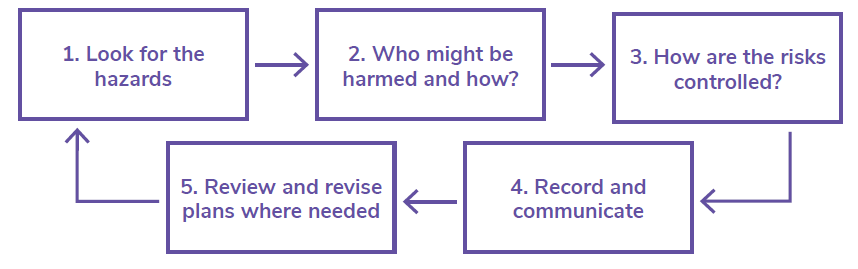
For more information, templates and examples, visit our Risk Assessment guidance page