Compleating your Challenge Award
A short guide for young people and volenteers to support with compleating a Challenge Award
Challenge Award Guide
This guide is here to help you complete your challenge award.
Use what you find helpful. Ignore what isn’t.
A challenge award is your chance to choose something that matters to you, take it on in your own way, and show what you did and what you learned.
This guide can help you:
- plan something you actually care about
- get started when you’re not sure what to do
- keep track of what you’ve done
- capture moments, not perfect writing
- notice what you’ve learned along the way
What counts
What matters is that your challenge shows something real and meaningful.
That might include:
- trying something new
- learning something
- bringing people together
- dealing with problems
- creating something
- making a difference
- reflecting on what happened
Your challenge will show some of these more than others – that's expected and will change person to person.
Do it your way
There isn’t one right way to complete a challenge award. You should pick a challenge that interests YOU and complete it in a way that works for you. This means everyone’s challenges will look different and how they present and track their challenges will look different too.
Write loads. Write hardly anything. Sketch, stick, screenshot, scribble. Do what you want, how you want to do it.
You don’t have to do things in a set order, and one activity can count for more than one area.
Aspects of your challenge
Over the challenge, your experiences should show you’ve:
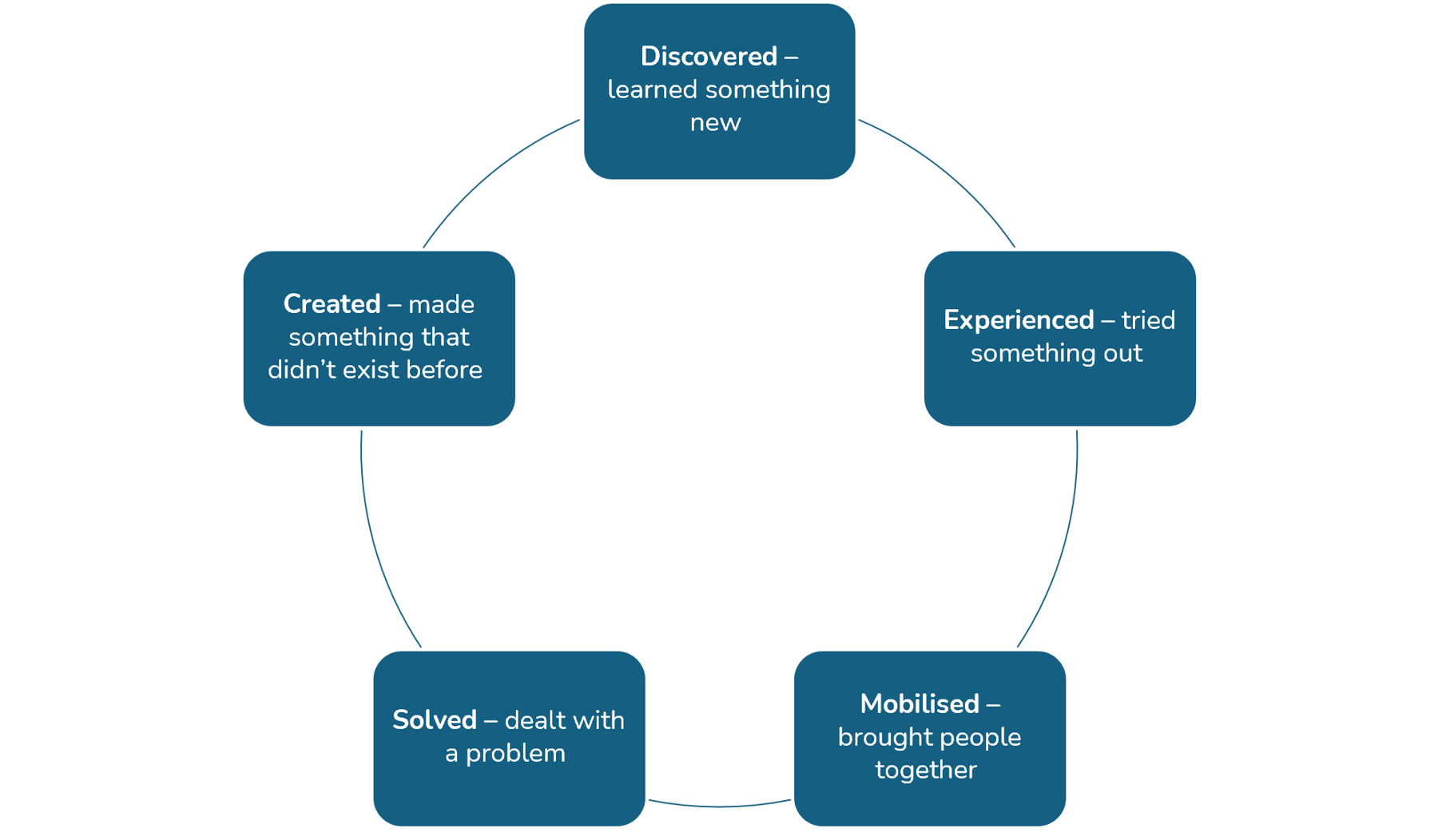
You do not have to do these in a set order, and your challenge might show some of them more than others.
At the end of each challenge, you’ll also need to reflect on how it went and what you learnt. This can sometimes feel daunting or maybe boring, but reflecting on what you’ve done will show you how much you’ve learnt, accomplished and grown!
What to focus on
- Help Explorers choose something meaningful to them
- Reinforce that there isn’t one “correct” way to complete a challenge
- Encourage confidence and ownership
What to avoid
- Turning the challenge into a checklist exercise
- Suggesting one “best” type of evidence or format
- Over-correcting ideas too early
How you can support
- Ask open questions rather than giving ideas immediately
- Reinforce that small, genuine challenges are valid
- Remind them that flexibility is expected, not a problem